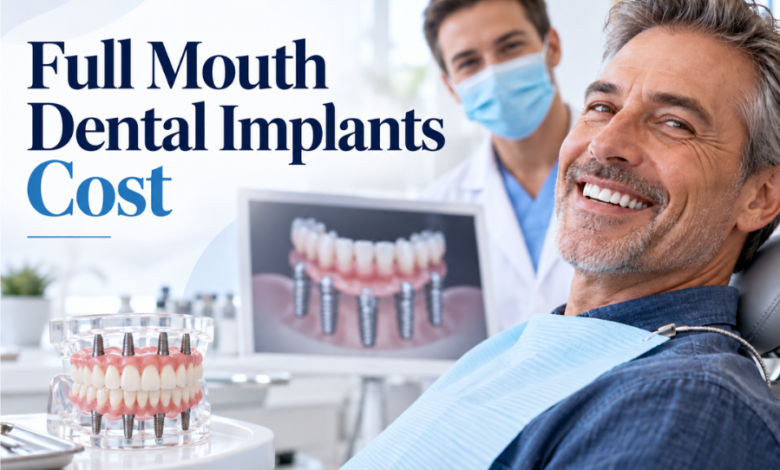
A full set of implant-supported teeth can cost tens of thousands of pounds or dollars, yet an advertised price rarely tells the whole story. The biggest distinction is whether a clinic is pricing one jaw or both, and whether the package ends with a permanent bridge or only temporary teeth. In the UK, published private-clinic starting prices for fixed full-arch treatment can be around £9,000–£14,000 per jaw. In the US, Aspen Dental reports an approximately $19,979 average per arch for its fixed full-arch patients in 2026. Those figures are not universal tariffs. Understanding full mouth dental implants cost means comparing the actual treatment delivered, the surgery required and the maintenance that follows. Here is how to evaluate the options without mistaking a headline offer for a final bill.
First, Understand What “Full Mouth” Means
A dental implant is an artificial tooth root placed in the jawbone. An abutment connects it to replacement teeth, while a bridge or denture provides the visible biting surface. Full-mouth restoration generally means treating both the upper and lower jaws, also called arches.
Many advertisements say “full mouth” while displaying a price for one arch. Both jaws may require two bridges, two sets of posts and additional surgery.
Before accepting treatment for both jaws, establish whether both genuinely need reconstruction. If one arch contains teeth with a good long-term prognosis, preserving them may avoid unnecessary extractions and considerably change the proposed cost.
Nor does a complete restoration necessarily require an implant for every missing tooth. A fixed arch can be supported by four or six strategically positioned implants. Another option is a removable denture that clips onto implants. Their maintenance and prices differ considerably.
Full Mouth Dental Implants Cost: UK and US Prices
What UK patients can expect
There is no official nationwide fixed price for private full-arch implants. Published UK practice fees illustrate the variation: London Dental Implants Clinic advertises fixed All-on-4 treatment from £9,000 for one arch, Comely Bank Dental in Edinburgh advertises from £12,500, and Sheffield Smiles lists All-on-4 from £14,000.
These are advertised starting prices, not individual quotations. More complex cases, additional implants or higher-end bridges can exceed £18,000 per jaw. For both jaws, a practical planning budget may therefore run from roughly £20,000 into £40,000 or more, depending on the package and necessary procedures. Some providers publish lower combined-arch starting offers, but inclusions must be checked carefully.
What US patients can expect
Aspen Dental publishes particularly useful 2026 figures from its own patients: approximately $19,979 per arch for fixed full-arch implants, with a reported range of $19,315–$30,878. These are provider figures rather than a representative national average.
A patient treating both jaws could consequently face a bill around $40,000 or substantially higher at that provider, depending on the final plan. Independent practices charge differently, making a nationwide price misleading.
For comparison, Aspen reports approximately $8,289 per arch for removable snap-on implant dentures, with a range of $7,628–$13,297. This is a different restoration, not a discounted fixed bridge.
Fixed Bridges, All-on-4 and Snap-On Dentures Are Not Interchangeable
All-on-4 describes a fixed full-arch bridge supported by four implants. The rear implants are often angled to make use of available bone. It may reduce grafting in suitable patients, but cannot always avoid it.
All-on-6 uses six implants rather than four. Additional support may suit certain bones, bite forces or bridges. Six is not automatically better than four.
Implant-retained overdentures, sometimes called snap-on dentures, attach to implants but are removed for cleaning. They can be more stable than ordinary dentures and usually cost less than fixed bridges. Attachments may wear.
A conventional complete denture uses no implants and is generally the lowest-cost option. It may suit patients avoiding surgery, although fit and chewing stability differ.
Compare whether teeth are fixed or removable, and how cleaning and repairs work.
The Items That Can Push a Quote Higher
Extractions and the condition of existing teeth
Removing damaged teeth, treating infections or stabilising periodontal disease can increase the initial cost. Tooth removal is irreversible; assess preservation options before accepting full-arch treatment.
Bone grafting and advanced imaging
Implants need adequate bone and safe positioning. Three-dimensional cone-beam CT imaging may help clinicians assess anatomy and plan placement. Insufficient bone can require grafting.
Guy’s and St Thomas’ NHS Foundation Trust explains that bone grafting can add four to six months to an implant treatment journey. Not every patient needs a graft, and some full-arch designs aim to work around areas of reduced bone.
The permanent bridge and its materials
Acrylic or composite-based bridges and zirconia restorations can carry substantially different prices. The cheapest quoted bridge may be a temporary appliance, with an additional charge for definitive teeth after healing.
Materials affect appearance, weight and repair options; no single material suits everyone.
Sedation, laboratory work and aftercare
Local anaesthetic is commonly used for implant surgery, but some patients choose or require sedation. Its fee may be separate. Laboratory work, night guards and reviews may also cost extra.
Ask whether scans, extractions, implants, abutments, temporary teeth, final teeth, sedation and follow-up appointments are included. A quote is only comparable when these items are identified.
Why “Teeth in a Day” Does Not Mean Treatment Ends That Day
Some eligible patients receive a temporary fixed bridge shortly after their implants are placed. That does not mean healing is complete or final teeth have been delivered.
The implant must integrate with the jawbone, a biological process called osseointegration. Leeds Teaching Hospitals describes a typical integration period of two to six months, depending on the case. The definitive bridge is usually planned after healing, with visits to refine the fit, bite and appearance.
A more involved treatment may include an assessment, scans, extractions, grafting, implant placement, provisional teeth and later final restoration. Ask for a realistic timeline alongside the payment schedule, including what happens if healing takes longer than expected.
NHS Funding, US Insurance and Finance Options
In the UK, implants are ordinarily private treatment. The NHS says they are occasionally available for patients who cannot use dentures for particular reasons, including circumstances following mouth cancer or an accident. Routine full-arch replacement is not normally funded, although NHS dentures may be an alternative.
In the US, dental insurance may contribute to certain implant-related services, but coverage is highly plan-specific. The American Dental Association notes that dental plans commonly impose annual maximums, exclusions and other restrictions. A policy that mentions implants does not necessarily pay for full-mouth fixed bridges.
Before treatment, request an insurer’s written estimate of benefits and ask the dental practice to distinguish covered items from patient charges. Predetermination is not a payment guarantee.
Some clinics offer instalment arrangements or third-party financing. Compare the total repayable amount, annual percentage rate, deposit, credit-check requirements and consequences of missed payments. Monthly prices can obscure total costs.
The Costs Continue After the Final Bridge Is Fitted
Implants are designed for long-term use, but they do not come with a promise of lifelong trouble-free service. Bridges can chip, wear or require repair; screws and removable-denture attachments can also need attention. Professional cleaning and periodic examinations are continuing expenses.
The US Food and Drug Administration identifies possible complications including infection, loosening, nerve injury and implant failure. Smoking can impair healing, while untreated gum disease and poorly controlled diabetes may raise clinical risks. These factors deserve discussion before surgery, not after a complication appears.
Implant-supported teeth must be cleaned around the bridge, gums and supporting components. The American Academy of Periodontology recommends ongoing home hygiene and regular professional monitoring to help prevent disease around implants.
Ask the practice to record the implant brand and model and explain whether replacement components will remain accessible if you move or need care elsewhere.
When comparing prices, ask for a maintenance plan and typical charges for hygiene visits, removal and cleaning of a fixed bridge where indicated, replacement parts and repairs. Any warranty should specify exactly what is covered and whether routine visits are a condition of eligibility.
Is Travelling Abroad a Sensible Way to Save?
Overseas clinics may advertise substantially lower prices, but surgery and final restoration can require multiple appointments months apart. Flights, accommodation, time away from work and return visits can narrow the initial saving.
The British Dental Association has warned about complications and difficulties arranging remedial treatment after dental tourism. Verify qualifications, implant systems and follow-up arrangements before travelling.
If a problem emerges after returning, a local dentist may not be able to obtain compatible components or take responsibility for another provider’s work. Include that risk when comparing costs.
How to Compare Two Quotes Fairly
Before paying a deposit, obtain at least two clinically informed opinions where practical. A transparent proposal should answer the following questions:
- Is the price for one arch or both, and are the final teeth included?
- How many implants are proposed, and why is that design appropriate?
- Are extractions, scans, grafts, sedation and temporary teeth included?
- What happens financially if an implant fails to integrate?
- Who performs the surgery and who provides subsequent maintenance?
- Which fees remain payable after the advertised package is completed?
The UK’s Competition and Markets Authority advises patients to obtain a written treatment plan and clear costs before proceeding. Compare the diagnosis, alternatives and clinician’s experience too.
Conclusion
Full mouth dental implants cost depends most on whether both jaws are treated, whether the replacement teeth are fixed or removable, and which surgical and restorative stages the price includes. Published UK clinic fees and US provider data show why a five-figure advertisement cannot substitute for a personal treatment plan. The soundest decision comes from comparing complete written quotations, understanding the risks and budgeting for maintenance after the final teeth are fitted.
FAQs
How much do full mouth dental implants cost for both jaws?
For fixed teeth on both jaws, UK patients may need to budget roughly £20,000–£40,000 or more, depending on the clinic and treatment complexity. In the US, Aspen Dental’s published 2026 per-arch average implies nearly $40,000 for two arches before case-specific differences. These are planning illustrations, not guaranteed prices or nationwide averages.
Can I get a full set of implants for less than £10,000?
Some UK clinics advertise one fixed arch below £10,000, but that usually does not mean both jaws. Removable implant-retained dentures or conventional dentures may offer less expensive routes to replacing many teeth. Confirm whether any offer includes surgery, temporary restorations, permanent teeth and necessary preparation.
Are four implants enough to replace every tooth?
Four implants can support a complete fixed bridge in one jaw for suitable patients, which is the principle behind All-on-4. Treating both jaws may involve four implants in each arch, but there is no universal requirement. Bone anatomy, medical history and the proposed bridge determine the treatment plan.
How long do full mouth dental implants last?
Implants can function for many years, but no clinician can guarantee they will last a lifetime. Long-term outcomes depend on oral hygiene, smoking, gum health, medical conditions and bite forces. The supporting implants and attached bridge have different maintenance and replacement needs, so ask about each separately.
Does insurance cover full mouth implants?
In the UK, NHS funding for dental implants is uncommon and generally restricted to particular clinical circumstances. In the US, coverage depends on the individual dental policy, with potential exclusions and annual benefit caps. Request a written breakdown from the insurer and dentist rather than assuming the advertised procedure is fully covered.