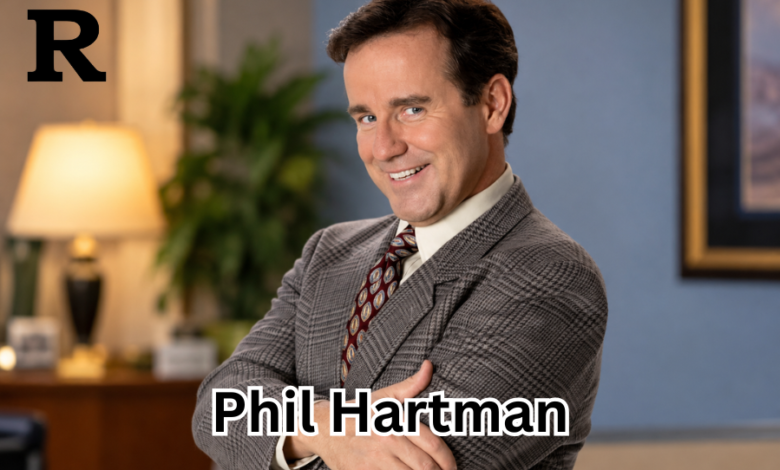
Phil Hartman spent eight seasons on Saturday Night Live, yet his greatest contribution was not any single impression. He could make an eccentric sketch believable, give another comedian the perfect straight man or turn a self-important character into the joke without raising his voice. That unusual range earned him the nickname “The Glue” among his colleagues.
Born in Canada and trained as a graphic designer, Hartman also helped shape Pee-wee Herman, supplied unforgettable voices on The Simpsons and starred in NewsRadio. His death in 1998, aged 49, ended a career still gathering momentum. The performances he left behind reveal a comedian whose precision, rather than a loud signature persona, made him indispensable to American television.
Quick Bio
| Detail | Information |
|---|---|
| Full Name | Philip Edward Hartmann |
| Known As | Phil Hartman |
| Date of Birth | September 24, 1948 |
| Birthplace | Brantford, Ontario, Canada |
| Date of Death | May 28, 1998 |
| Age at Death | 49 years |
| Nationality | Canadian-American |
| Profession | Actor, Comedian, Screenwriter, Voice Actor, Graphic Designer |
| Education | California State University, Northridge |
| Famous For | Saturday Night Live, The Simpsons, NewsRadio |
| Spouse at Death | Brynn Hartman |
| Children | 2 |
| Years Active | 1970s–1998 |
| Net Worth | Not publicly verified |
| Notable Award | Primetime Emmy Award (1989) |
Why Saturday Night Live Needed “The Glue”
Hartman joined Saturday Night Live in 1986, when the long-running NBC programme was entering a new creative period. Working alongside performers including Dana Carvey, Jan Hooks, Jon Lovitz and Kevin Nealon, he soon became one of the ensemble’s most dependable players.
That talent became particularly visible when he portrayed authority figures. Whether playing a politician, presenter or executive, he established an air of confidence before exposing the vanity underneath. His carefully controlled expressions and deliberate speaking rhythm often did more work than an elaborate costume.
The nickname “The Glue” recognised this stabilising presence. It also describes something easily missed when reviewing his highlights: the performers around Hartman frequently benefited from the credibility he supplied.
A Graphic Designer Before He Was a Television Star
Hartman was born on 24 September 1948 in Brantford, Ontario. His family moved to the United States when he was ten, and he later lived in Southern California. Before pursuing comedy professionally, he studied graphic arts at California State University, Northridge.
Design was not merely an early job to pay the bills. Hartman produced artwork for established recording artists, including Poco and America, and contributed to the visual identity of Crosby, Stills & Nash.
Among his recognised projects were the covers for Poco’s Seven and Legend, along with America’s compilation History: America’s Greatest Hits.
The Groundlings and the Making of Pee-wee Herman
In 1975, Hartman joined The Groundlings, the Los Angeles improvisational and sketch-comedy company. He remained associated with the troupe for more than a decade, developing the character work that would later define his television career.
There he collaborated with Paul Reubens as Reubens developed Pee-wee Herman, the eccentric, childlike character who moved from live comedy into television and cinema. Hartman contributed as both a performer and a writer rather than simply appearing beside an already established star.
He played Captain Carl in The Pee-wee Herman Show and Pee-wee’s Playhouse. He also shared screenplay credit with Reubens and Michael Varhol on Pee-wee’s Big Adventure, the 1985 film directed by Tim Burton.
From Bill Clinton to the Unfrozen Caveman Lawyer
Hartman’s impressions on Saturday Night Live included Bill Clinton, Frank Sinatra, Ronald Reagan and television personality Phil Donahue. He rarely relied on resemblance alone; his portrayals focused on mannerisms, social status and the gap between public confidence and private absurdity.
His Clinton became one of the programme’s defining political impressions of the early 1990s. The humour came not only from an imitation of a familiar president but from Hartman’s ability to suggest a politician who felt comfortable charming almost anyone.
His original characters displayed the same instincts. The Unfrozen Caveman Lawyer presented himself as overwhelmed by modern civilisation while skilfully manipulating courtroom sympathy. Hartman’s straight-faced performance made the character’s transparent dishonesty funnier.
Hartman left SNL in 1994. His work had already earned him a shared Primetime Emmy for writing in 1989, while his individual performance received an Emmy nomination in 1994.
Two Simpsons Voices That Could Not Be Replaced
Hartman’s animation work gave him a different form of freedom. On The Simpsons, he voiced Troy McClure, the faded actor forever promoting questionable past projects, and Lionel Hutz, a lawyer whose confidence far exceeded his competence.
Although the characters looked and behaved differently, they drew on the same comic contradiction. Both wanted respectability; neither could recognise how thoroughly his own behaviour undermined it. Hartman’s smooth, promotional voice made their self-deception instantly recognisable.
Troy McClure was especially suited to his gift for sounding authoritative about nonsense. Hutz used similar vocal assurance in the courtroom, where his disastrous legal judgement was often delivered as though it were sound professional advice.
The series retired both characters after Hartman’s death rather than assigning their speaking roles to another actor. His final guest appearance, in the episode “Bart the Mother”, aired in September 1998 and was dedicated to his memory.
NewsRadio Revealed Another Side of His Timing
After leaving SNL, Hartman joined NBC’s workplace sitcom NewsRadio, which began in 1995. Set at a fictional New York radio station, it gave him a regular role as Bill McNeal, a news anchor whose professional polish concealed extraordinary self-regard.
Unlike a brief sketch, a sitcom required that personality to remain entertaining over multiple seasons. Hartman found variation in Bill’s arrogance, insecurity and habit of treating everyday workplace disagreements as matters of historic importance.
He worked within an ensemble that included Dave Foley, Maura Tierney, Stephen Root and Andy Dick. The show’s rhythm depended on fast exchanges, and Hartman’s ability to punctuate a scene without overwhelming his colleagues suited its writing.
His performance brought a 1998 Emmy nomination for outstanding supporting actor in a comedy series. It demonstrated that his strengths were not restricted to impersonation or short-form sketch work.
Film audiences also saw him in Houseguest, Sgt. Bilko and Jingle All the Way. His voice appeared in the animated-feature hybrid Small Soldiers, released after his death. These roles extended his reach, although television remained the clearest showcase for his ensemble instincts.
His Death and the Response From Colleagues
Hartman married Brynn Omdahl in 1987, and the couple had two children. On 28 May 1998, he was shot and killed by Brynn at their home in Encino, Los Angeles. She subsequently died by suicide. Hartman was 49.
Contemporary police reporting documented the deaths as a murder-suicide. Accounts of the couple’s difficulties circulated afterwards, but speculation about their relationship cannot replace the established facts or explain away the violence.
The loss confronted his colleagues with both personal grief and practical decisions about continuing their programmes. NewsRadio addressed Bill McNeal’s absence in its next season by having the character die of a heart attack. Former SNL colleague Jon Lovitz joined the cast in a different role.
Recognition for a Career Built on Collaboration
Hartman’s professional record includes one Primetime Emmy win and four nominations in total. In 2012, he was inducted into Canada’s Walk of Fame, recognising the Canadian-born entertainer’s contribution to television and comedy.
Two years later, he received a posthumous Hollywood Walk of Fame star in the television category. Kevin Nealon and Jon Lovitz were among those taking part in the ceremony, where Hartman’s brother John accepted the honour.
The Groundlings had already dedicated its theatre to his memory in 1999. Together, those tributes reflect a career that connected improvisation, screenwriting, sketch comedy, animation and sitcom acting.
Conclusion
Phil Hartman’s legacy is not simply the number of memorable people he impersonated. It is the discipline with which he created them, the generosity he brought to ensembles and the range that carried him from album artwork to influential television comedy.
Saturday Night Live, The Simpsons and NewsRadio remain powerful evidence of a performer who understood that making a scene work could matter more than stealing it.
FAQs
What was Phil Hartman best known for?
He was best known for his eight seasons on Saturday Night Live, where his political impressions and original sketches made him an essential ensemble member. He also voiced Troy McClure and Lionel Hutz on The Simpsons and played Bill McNeal on NewsRadio. His work combined writing, character acting and distinctive vocal performance.
Why was Phil Hartman called “The Glue”?
The nickname referred to his ability to hold Saturday Night Live sketches together. He was a versatile performer who could play the central comic character or support another cast member with a convincing straight-faced response. His reliability helped complicated scenes retain their rhythm and made the ensemble stronger.
How old was Phil Hartman when he died?
Hartman was 49 years old. He was born on 24 September 1948 in Brantford, Ontario, and died on 28 May 1998 in Encino, California. His death came while he was appearing on NewsRadio and continuing to provide voices for The Simpsons.
Did Phil Hartman create Pee-wee Herman?
Paul Reubens created and performed Pee-wee Herman, while Hartman played an important collaborative role in developing the character. Both were associated with The Groundlings, and Hartman later appeared as Captain Carl in Pee-wee productions. He also co-wrote the 1985 film Pee-wee’s Big Adventure with Reubens and Michael Varhol.
What was Phil Hartman’s net worth?
Hartman’s exact net worth at the time of his death is not publicly verified by reliable financial documentation. Online estimates vary and should not be confused with audited records of assets, income or liabilities. His well-documented achievements are in graphic design, television performance, voice acting and screenwriting rather than a confirmed personal fortune.
READ THIS TOO: Beckett O’Brien: Conan O’Brien’s Son, His Harvard Years and Life Away from Fame