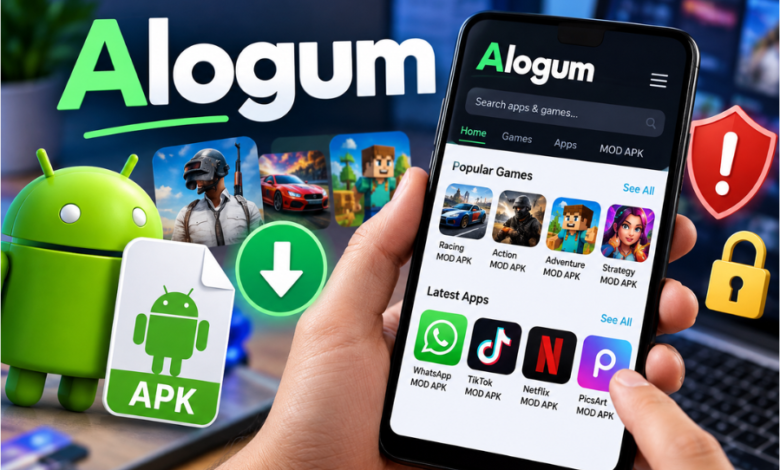
ALOgum is a third-party website promoting Android apps and games, including modified packages that advertise unlocked features or extra in-game resources. Its appeal is straightforward: users can browse software outside Google Play and explore versions that ordinary app stores may not offer. Yet an attractive download description says little about who built a file, whether it has been altered safely, or who will maintain it. Alogum’s own published terms make those questions especially important. The site describes its service as free but also places responsibility for risks associated with modified downloads on users. Understanding Alogum therefore involves more than identifying its catalogue. It means examining how Android packages work, what the platform actually promises, and the precautions that matter before any installation.
What Alogum Actually Offers
The website presents itself as a discovery and download destination for Android software. Its main navigation separates games into categories including action, adventure, racing, strategy and simulation, while its app categories cover entertainment, productivity, music and tools.
The distinction between an original application and a modified one is central. An original APK is generally intended to contain software as distributed by its developer, although a third-party label alone does not establish authenticity. A MOD APK has been changed from an original release. Changes may include altered game balances, removed restrictions or advertised access to paid features.
The site’s listings include familiar editing applications and mobile games, with descriptions such as premium unlocked or unlimited currency. These are claims attached to listings, not independent confirmation that a package performs as advertised.
The Download Experience Has an Important Missing Layer
ALOgum says it collects modifications from internet sources, tests versions and considers user feedback before recommending them. Those statements describe its intended process. They do not amount to a publicly demonstrated security audit of every listed download, nor do they identify the original developer behind every modified package.
A practical assessment begins with the destination of a download, not the promotional headline. Does it lead to the publisher’s own release, a separate file host or a repackaged version whose creator cannot be identified? Are the version number, release date and package details consistent with the publisher’s records? If those questions remain unanswered, there is little basis for assuming the file is genuine.
Why MOD APKs Create Different Security Questions
Android apps can request access to cameras, microphones, location, contacts, files and other device functions. Many legitimate applications need some permissions to work. The risk changes when a package comes from an unidentified modifier, because users cannot easily tell what code was added or removed.
A modified application could simply change a game mechanic. It could also contain unwanted advertising components, invasive tracking or malicious functionality. None of those possibilities proves that a particular Alogum file is harmful. They explain why unknown provenance is a security issue rather than a minor technical detail.
Google Play Protect checks apps from Google Play and other sources, warns about potentially harmful software and may block or remove detected threats. It is a valuable safeguard, but no protective system can promise perfect detection. Users still need to assess publishers, download sources and unusual permission requests.
One Piece of Alogum Guidance Deserves Particular Scrutiny
A notable detail appears in the site’s published installation instructions. Under troubleshooting for an app that will not install, the guidance suggests switching off Play Protect. That conflicts with Google’s recommendation to keep Play Protect enabled to help identify harmful applications.
An installation warning should not be treated as an inconvenience to bypass automatically. It may result from an incompatible version, a conflicting package signature, a damaged download or a genuine security concern. Disabling protection before identifying the cause removes an important layer of scrutiny at precisely the point it may be needed.
The safer response is to stop and investigate. Check whether the developer offers a legitimate compatible build, whether the file has the expected signing identity and whether Android has raised a specific warning. If verification is impossible, declining the installation is more defensible than weakening device security.
APKs, Split Packages and the Update Problem
An APK is an Android application package used for installation. Some apps also depend on additional assets or split packages, meaning a standalone file may not contain everything needed to run correctly. ALOgum’s installation guide discusses APK, APKS and OBB files, reflecting the variety of formats users may encounter.
Installation is only the beginning of the software lifecycle. Android expects an update to match the installed application’s identity and signing certificate, subject to recognised signing-key rotation. Modified builds may use a different signature from the official release, which can prevent an ordinary update from installing over them.
Delayed fixes can be more serious than missing new features. Security updates often address vulnerabilities that would otherwise remain exposed. Before installing any external package, ask who will provide future updates and how their authenticity can be checked.
What the Website’s Terms Say About Responsibility
ALOgum describes its content and service as free. Its published terms also say downloads shared with third parties are outside its responsibility, and users assume risks associated with MOD files. The terms refer to advertising from outside companies and limit the site’s responsibility for dealings with advertisers.
Those provisions matter because free access and accountable distribution are different promises. A service can make software easy to find without providing a warranty that a particular file is safe, licensed or supported. Readers should not mistake a general claim of reliability for a contractual assurance or an independently documented testing programme.
The site’s public materials do not provide enough independently verified detail to confidently identify its corporate ownership, financial position or current management.
Free Access Does Not Settle Copyright or Account Rules
Android permits installation from outside Google Play, but technical permission is not the same as authorisation from a software owner. Developers may distribute their own APKs directly. Open-source projects may also permit redistribution under specified licences. Those are different situations from an unofficial alteration that bypasses payment, licensing or access controls.
A modification advertising premium features without payment deserves scrutiny. Whether distributing or using it infringes rights depends on the software, the applicable law, the licence and the actions involved. In the United States, the Digital Millennium Copyright Act also restricts certain circumvention of technological measures, subject to exceptions. UK copyright rules differ, so sweeping claims about the legality of every MOD APK are unreliable.
The copyright question sits alongside platform rules. Online games and subscription applications can enforce terms of service or account entitlements independently of installation. A modified app may fail to connect, lose functionality or trigger an account restriction under applicable service rules.
A site’s mention of copyright compliance does not establish that each modified download has permission from its original publisher. The safest route to paid features remains the authorised version, subscription or licence offered by the developer.
A Sensible Checklist Before Installing Anything
Start by checking whether the application is available through Google Play or the developer’s verified distribution channel. If it is, that usually provides a clearer route for updates, support and accountability. If an external package is necessary, establish exactly who publishes it and why it is being offered separately.
Next, examine the specific file rather than relying on the reputation of a directory. Compare its version information and publisher identity against authoritative records. A cryptographic checksum is useful only when it comes from a genuinely trusted publisher; copying a checksum from the same unverified download page does not independently authenticate the software.
Keep Play Protect enabled and Android updated. Review installation prompts and app permissions, especially requests unrelated to the advertised function. A simple game that unexpectedly asks for sensitive access warrants additional questions.
Avoid signing into important accounts through altered applications whose origin cannot be confirmed. Financial apps, password managers, messaging services and software holding sensitive personal information deserve particularly strict standards. If an installation displays unexpected behaviour, remove the app, run a security check and review affected account security using a trusted device when needed.
Finally, consider whether the supposed benefit is worth ongoing maintenance. A free modification that cannot receive reliable updates may become more expensive in lost time, data or account access than the authorised product it replaces.
Where Alogum Fits Among Android Download Options
The meaningful distinction is governance. Does a service identify publishers, describe its review processes, publish a responsible security contact and provide dependable updates? Are developers distributing their own work, or is an unknown third party offering modified copies?
For most mainstream applications, the official publisher’s channel remains the clearest starting point.
Alogum Also Has an Older Meaning Beyond Android
The spelling has a separate linguistic history. Latin dictionaries record alogus, aloga, alogum, an adjective derived from Greek and associated with irrationality or irregularity. In specialised historical contexts, it could describe a mathematical quantity that did not correspond to another or an irregular element of verse.
The word also appears in Penicillium alogum, a fungal species formally described in a 2016 scientific publication. Researchers selected the name to reflect irregular branching in its spore-producing structures. The original specimen came from tundra wetland soil in Wyoming’s Wind River Range.
Neither the Latin record nor the fungal classification explains the Android website’s branding. There is no verified basis for claiming its operators adopted the name from either source. Searchers should therefore distinguish the website, the Latin form and the scientific species rather than combining them into one invented origin story.
Conclusion
Alogum illustrates the attraction and the trade-offs of independent Android distribution. Its listings make modified games and applications easy to discover, but advertised features are not proof of authenticity, licensing or safety. The site’s own terms and its advice about Play Protect make independent verification especially important. For readers considering a download, the decisive question is not whether a file promises more features. It is whether its publisher, code and future updates can be trusted.
FAQs
What is Alogum used for?
ALOgum is a website where people browse Android games and applications, including original and modified APK listings. Some modifications advertise unlocked features or additional game resources. It is independent of Google Play, and a listing does not automatically confirm developer authorisation or file security.
Is Alogum safe to download from?
There is no sound basis for declaring every download safe or unsafe without examining individual packages. The site’s descriptions are not equivalent to independent malware testing. Check the file’s origin, publisher identity and permissions, keep Play Protect active, and prefer a verified developer source whenever possible.
Is Alogum an official Android app store?
No. It operates as a third-party website rather than Google’s official Play Store. Android can install software distributed outside Google Play, but users must take additional care over authenticity, installation permissions and updates. The existence of a downloadable APK does not mean Google has reviewed that particular file.
Why might an Alogum MOD APK fail to update?
Android checks package identity and signing information when installing updates. A modified version signed differently from the developer’s official build may not update through Google Play. Compatibility problems or missing installation components can also cause failure. Avoid uninstalling a data-heavy app before understanding the risk of losing locally stored information.
Does Alogum mean something in Latin?
Yes. Alogum is a form of the rare Latin adjective alogus, associated with meanings such as irrational or irregular. It also appears in the scientific name Penicillium alogum. Neither fact establishes how the Android website chose its name, and the website should not be confused with the fungal species.