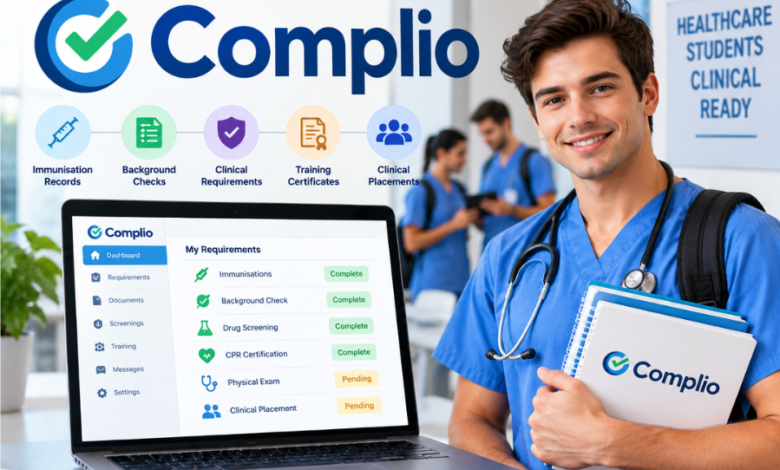
Complio helps healthcare students prove they have completed the checks and paperwork required before entering clinical settings. Used by nursing schools and other health-related programmes in the United States, the online compliance management platform brings immunisation records, background screening and training documentation into one organised process. For students, that process can determine whether they are cleared to attend a placement on time.
The service has also undergone a significant corporate change: American DataBank, the company behind Complio, was acquired by DISA Global Solutions in 2025. Yet the practical questions remain familiar. How do you register, what belongs in your account, why might a document be rejected, and who decides whether you are compliant? Understanding those distinctions makes Complio considerably easier to navigate.
What Complio Is—and What It Is Not
Complio is a digital system for collecting, assessing and tracking evidence of compliance with requirements established by educational institutions and clinical partners. Students enter information, upload documents and monitor their status. Authorised reviewers check whether the submitted evidence satisfies the rules configured for their programme.
It is not a replacement for a doctor, an electronic health record or an independent clinical licensing authority. Receiving a compliant status means a defined collection of requirements has been satisfied within the relevant programme. It does not automatically grant professional registration, admission to a course or approval for every possible hospital placement.
Developed by American DataBank, the software now sits within DISA Healthcare Technology. Some schools still use the former company’s name, while newer materials refer to DISA Complio. Students should follow their own institution’s instructions.
Why Clinical Programmes Need a System Like This
Hospitals and community healthcare facilities must consider patient safety, staff protection and contractual conditions when accepting trainees. A student may need evidence of immunity to specified diseases, current life-support training and acceptable screening results before beginning hands-on clinical work.
Across large cohorts, documents arrive at different times and several credentials expire before graduation. Complio gives schools a central view of completed and outstanding obligations.
Its use extends beyond nursing. Kennebec Valley Community College lists programmes including emergency medical services, occupational therapy, radiologic technology and respiratory therapy among those using the service. The exact mix depends on each institution, not on a universal checklist set by Complio itself.
The Records Students May Be Asked to Provide
A typical account contains categories designed around the institution’s requirements. Immunisation evidence may include vaccine records, laboratory reports showing antibody levels, tuberculosis screening results or an approved alternative where the programme permits one.
Other categories may cover criminal background checks, drug screening, cardiopulmonary resuscitation or basic life-support certification, physical examinations, insurance documentation, training certificates and signed acknowledgements. Some programmes request proof of professional licensure or additional site-specific paperwork.
The University of Connecticut warns that ordinary medical documents do not always contain sufficient detail for compliance review. Records generally need identifying information, a service or test date, provider details and relevant results. Some laboratory results require reference ranges for correct interpretation.
A clear photograph of a vaccination card may be accepted, but an illegible image can be rejected. Check the specific instructions before requesting records or paying for tests.
Getting Started: From School Instructions to a Working Account
The safest starting point is the registration guidance issued by the university, college or clinical-placement coordinator. Institutions can have customised Complio environments and programme-specific packages. Using an unrelated registration page risks selecting the wrong requirements or purchasing an unsuitable service.
Users typically create a profile and choose their institution’s programme or subscription. They may then order screening, arrange a drug test or complete forms inside the account.
Before uploading, students should compare displayed requirements with the official checklist and gather their existing records.
The next step involves entering any required dates or results, attaching documentation to the correct category and submitting it for review. Some categories contain several separate items. For example, evidence of a vaccine series may need to be matched to individual doses instead of being attached once to the general immunisation heading.
A file may cover several requirements if associated with each correctly. The dashboard then displays accepted, outstanding and pending items.
Why a Submitted Document Can Still Show as Incomplete
One of the most confusing aspects of Complio is the difference between sending a file and achieving approval. A document may be stored in an account but still be unassociated with the required item, awaiting verification or unsuitable as evidence.
Reviewers may reject submissions because names do not match, important dates are missing, test results cannot be interpreted or the wrong certificate was provided. An incomplete vaccine series may also leave a category non-compliant even when one dose has been documented.
Review is not instant. South Texas College advises allowing up to three business days for its Clinical Affairs Department to check uploads.
A flagged background report is different from a rejected upload. It may indicate information requiring attention, an expired order or a screening result needing investigation. DISA explains that individuals can dispute inaccurate reported information; admission and placement decisions remain with the relevant institution.
When a document is rejected, the useful first step is to read the reviewer’s comments rather than upload the same file again. The correction might require a clearer scan, an additional report, revised information or a discussion with the programme coordinator.
Expiration Dates Can Change Your Status
Compliance is ongoing rather than a single task completed at enrolment. CPR credentials, screenings, annual training and some health requirements may need renewing while a student remains in the programme.
DISA Healthcare describes automatic expiry notifications within Complio, with standard reminder points that institutions can customise. These alerts are useful, but students still need to check whether a school requires renewal earlier than the date shown on an existing document.
A certificate that was acceptable at the beginning of a semester could expire before the final clinical rotation. Similarly, an approved screening result may become too old for a particular placement site.
Check the dashboard and maintain a personal calendar; notifications should not replace either.
Complio Pricing: Why There Is No Single Student Fee
Costs depend on the institution, the package ordered and the services required. A tracking subscription, background screening, fingerprinting or drug test may carry different charges. Courts and third-party screening providers can also affect background-check costs.
Everett Community College, for instance, lists a specific annual tracking-account fee and separate background-check charges for its healthcare programmes in 2026. Those figures illustrate how pricing can be structured, but they are not a universal Complio tariff.
Confirm the package, renewal terms and any available reimbursement before paying.
Privacy, Access and Sharing Clinical Readiness
Complio processes sensitive personal information, including health documentation and screening records. Students should therefore enter details only through the official access route supplied by their institution and protect their account credentials.
Access is not necessarily open to every lecturer or placement employee. Institutions can define authorised users and procedures for sharing compliance information with clinical partners. DISA also provides support resources covering profile sharing.
Read privacy notices and consent forms before sharing records with hospitals or placement systems. Keep secure copies outside the account too.
A compliant dashboard does not guarantee acceptance by future employers or licensing authorities.
Who Makes the Final Decision?
Complio helps administer the process, but schools and clinical providers determine their requirements. The software does not independently decide which vaccinations a university must require or whether a specific placement can accept an exemption.
Some arrangements involve review by the service provider; others rely on institutional administrators. South Texas College, for example, identifies its own Clinical Affairs Department as the reviewer of uploaded items. That is why instructions and turnaround times can differ between institutions using the same platform.
Exceptions require institutional guidance and may not satisfy every clinical site. Discuss placement implications with your coordinator.
How the DISA Acquisition Changed the Corporate Picture
On 4 February 2025, DISA Global Solutions announced its acquisition of American DataBank and the launch of a dedicated healthcare technology division. DISA had also acquired CastleBranch in 2024, bringing additional screening and compliance capabilities into the wider business.
The corporate development matters because students may encounter different branding in university guides, receipts and support materials. DISA Healthcare now lists Complio alongside other platforms, including myCB and Stargate, rather than treating them as one interchangeable login.
DISA has announced a planned internal merger of American DataBank into its parent company, emphasising service continuity. A branding change alone is no reason to abandon an account or buy another subscription.
The platform’s relevance remains its ability to align documentation with detailed, institution-specific rules, not the branding appearing above the login screen.
A Practical Routine for Staying Placement-Ready
Save legible documents as they become available and verify that names, dates and provider details are visible. Check the dashboard after every submission until approval appears.
Laboratory testing, screening appointments and corrected records can take time. When a deadline is at risk, contact the programme coordinator early rather than assume that an incomplete requirement will be excused.
Conclusion
Complio serves an important but specific role in healthcare education: it organises the records needed to demonstrate clinical readiness and helps institutions monitor requirements over time. Its place within DISA Healthcare reflects a broader business offering, while the central responsibility remains shared between students, reviewers and their schools. The key is understanding that a successful upload is only the beginning; timely approval and continued compliance are what matter.
FAQs
Is Complio only for nursing students?
No. Nursing programmes are prominent users, but the platform is also used in other health-related disciplines. Depending on the institution, these can include emergency medical services, medical assisting, occupational therapy, radiologic technology and respiratory therapy. Each programme sets its own checklist, deadlines and screening requirements.
How do I find the correct Complio login?
Use the directions provided by your school or clinical-placement office. Institutions may provide customised access routes, while DISA Healthcare also has a general Complio entry point. Avoid guessing from search results: choosing the wrong institution or ordering an incorrect package may complicate registration.
How long does Complio take to approve documents?
There is no universal approval time. Several universities advise allowing a few business days for review, while some programmes manage their own verification. Delays can occur when information is missing or a document needs correction. Submit records ahead of the official deadline and watch for reviewer messages.
Can I attend clinical placement while my status is pending?
Not necessarily. Many programmes require full compliance before a student can enter a clinical site. A pending upload may not count as approval, even if the necessary test or training has been completed. Ask your placement coordinator about your exact status rather than assuming submission is sufficient.
What should I do if my Complio document is rejected?
Open the relevant requirement and read the reviewer’s explanation. Check whether the record is legible, correctly dated, matched to your profile and attached to the appropriate item. Replace or supplement the document as instructed. If you believe the rejection is mistaken, contact the institutional compliance office or designated support team.
Does a Complio background check remain valid forever?
No. A completed report reflects findings at the time of screening, and institutions determine how recent it must be. Some require new checks annually or before specific placements. Employers and licensing authorities may conduct their own screening later, even when a student previously met every Complio requirement.