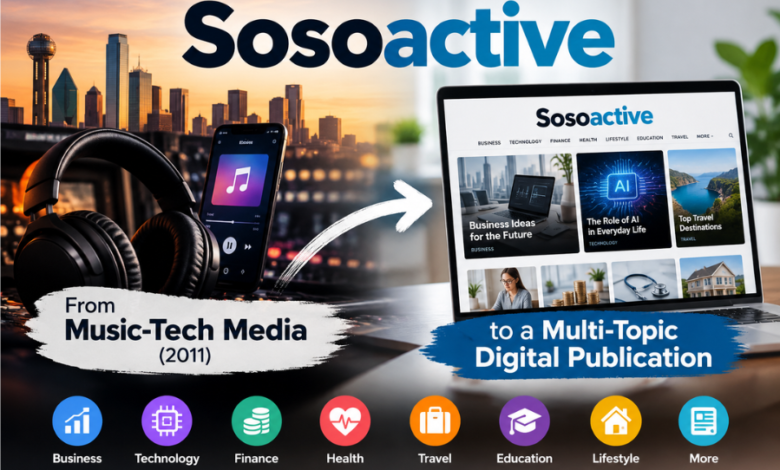
Sosoactive began as the name of a Dallas-based media business covering social music and mobile technology in 2011. Fifteen years later, the website most closely associated with that name looks very different: its pages explore entrepreneurship, artificial intelligence, finance, health and everyday consumer questions. Meanwhile, other websites use similar branding for their own editorial or lifestyle projects.
Its history captures a shift from specialist music commentary towards broad publishing, while raising questions about ownership and editorial purpose. The difference is especially important for readers trying to work out whether the name refers to a media company, a social app or a lifestyle service. Distinguishing the original business, current publication and similarly named websites explains what Sosoactive represents in 2026.
The Sosoactive Readers Encounter in 2026
The most visible present-day version of Sosoactive operates as an online magazine rather than a conventional social network. Its homepage is organised around articles, subject categories, publication dates and author bylines. Visitors can browse without first building a personal profile or joining a member community.
The range is striking. Business and entrepreneurship sit alongside finance, technology, education, healthcare, insurance and law. Additional sections cover travel, lifestyle, entertainment, real estate, automotive subjects and home-related advice. The mix targets readers seeking practical explanations.
Recent homepage entries illustrate that breadth. October 2026 articles discussed dropshipping versus reselling, business opportunities for retirees, legal plea deals, artificial intelligence in video production and the time involved in insurance underwriting. The subject matter extends well beyond the music industry associated with the original company.
The word “platform” can mislead. A publication distributes articles; a social network connects profiles and conversations. Visible Sosoactive features fit the first description.
A Music-Technology Story Before the Broader Magazine
The older SoSoActive Media identity is unusually well documented for a small digital publication. Its surviving LinkedIn company profile identifies Dallas, Texas, as its headquarters and 2011 as its founding year. CB Insights independently records the same year and location.
The original business described itself as an interactive media company following developments in social and mobile music. It covered emerging music applications, start-ups, product reviews, music technology news and interactive marketing. Its listed specialties included music marketing, advertising and social media promotion.
Smartphones, streaming and social networks were reshaping music discovery and promotion. Reporting on companies connecting technology with fan participation provided a focused editorial proposition.
Why the 2011 Starting Point Matters
In 2011, digital-music debates involved recommendation tools, social sharing, mobile access and artists’ relationships with services. Technology journalism increasingly overlapped with music-business reporting.
SoSoActive’s early description placed it directly within that debate. It was not presented as a record label or an audio-streaming service. Its stated role was to report on products, companies and marketing techniques reshaping an existing industry.
That positioning explains why older references seem disconnected from today’s articles about insurance or small-business finance.
The People Connected to Its Earlier Years
Kelland Drumgoole, also referred to in some historical coverage as K-Diamondz, is closely associated with the early SoSoActive story. A January 2021 report in D Magazine included SosoActive Media among organisations where he had previously worked in business development. That is independent confirmation of a professional connection.
His January 2012 Music Think Tank article examined Sean Parker, Spotify, Napster and competition between social-music services, closely matching SoSoActive Media’s documented focus.
Some later company and media summaries identify Drumgoole as a founder. However, the accessible historical LinkedIn description does not name a founder, and the available information does not establish who legally owns or directs the current publication. His documented past involvement should not be treated as proof of a present management role.
LinkedIn’s historical two-to-ten-employee classification is likewise not a verified current staff count.
How the Editorial Offering Has Shifted
Modern Sosoactive emphasises service journalism: guides helping readers compare options or make decisions. A consultancy guide differs sharply from reporting on a mobile-music application.
Business advice occupies a prominent position. The homepage has featured explainers on Pinterest marketing, side hustles, e-commerce models and business ideas for people approaching or enjoying retirement. These topics attract readers at different stages of starting or managing an enterprise.
Technology coverage is similarly practical. Articles address AI transcription tools, automated testing, online identity and applications of artificial intelligence in content production. Education, health and legal material widen the potential audience further, although each requires different standards of specialist expertise.
The site’s October 2026 updates demonstrate that it is not merely an archived publishing project. Visible dates on recently published articles establish ongoing editorial activity, even if they do not reveal readership figures, profitability or the number of people involved.
Breadth Creates Opportunities and Responsibilities
A wide editorial remit can help a publication reach readers who might never visit a specialist music outlet. It also makes consistency harder to judge. A strong guide to e-commerce does not automatically establish expertise in clinical medicine or legal proceedings.
For that reason, individual article quality matters more than the general promise of being informative. Readers should examine sourcing, author credentials, publication dates and the distinction between reported fact and opinion, particularly before acting on health, legal or financial information.
Why Similar Names Complicate the Picture
Sosoactive is no longer a name that points unambiguously to one web experience. Besides the established dot-com publication, a dot-net website uses similar branding while describing itself through lifestyle, activewear and contributor publishing. Its About page promotes activewear and lifestyle products as well as a guest-post blogging service.
That dot-net homepage also publishes articles across household, fitness, education, family and consumer subjects. The gap between its lifestyle-product description and its broad article directory is visible on the website itself; it should not be resolved by guessing how the business operates behind the scenes.
Other websites using variations of the name describe digital engagement, culture or modern living. Similar branding does not demonstrate that they share directors, editorial teams, ownership or commercial arrangements. There is insufficient reliable public evidence to treat all these properties as branches of one organisation.
For readers, this is more than a naming technicality. Someone remembering a music-industry article from years ago may reach a different site while searching today. Equally, a reader looking for a fitness product may encounter a business-information publication instead.
The safest approach is to identify the specific publication and the article being assessed, rather than attributing every Sosoactive claim or service to one supposedly unified brand.
What Can Be Said About Ownership and Location?
The original business records establish a Dallas connection. The historical LinkedIn and CB Insights profiles agree on both the location and 2011 founding year. They do not, however, provide an independently verified corporate history through to the present day.
A contemporary Crunchbase listing for the publishing website describes a business-information operation and gives Noida, India, as its location. That contrasts with the older Dallas record. The difference should not be reported as a confirmed headquarters relocation: directory entries can describe different periods, operators or submitted business information.
The modern website publicly displays author bylines and a general contact address, but such details do not conclusively establish beneficial ownership. Nor do they show whether the original company retained uninterrupted legal control of the brand or domain.
Financial claims require similar restraint. Reliable public figures for Sosoactive’s revenue, valuation, advertising income or acquisition history are not established by the available material. A business-directory listing, even one containing audience estimates or automated projections, is not a substitute for audited accounts.
Is There a Distinct Sosoactive Product or App?
The historical company’s emphasis on mobile-music applications sometimes leads to a misleading assumption: that SoSoActive itself must have been a music app. Its surviving business description primarily concerned reporting on other technology products, not operating a proprietary streaming catalogue.
The current publication presents a browsable website with topic pages and articles. A separate official Sosoactive mobile application, subscription service or social network with established account-based features could not be reliably confirmed from the public information reviewed.
Claims about private chat, virtual events, matchmaking or paid membership should therefore not be accepted simply because a third-party description calls the brand “interactive”. That adjective can describe editorial engagement or marketing as easily as a standalone social service.
For ordinary readers, the practical product is information. Articles can be consulted directly, while any additional service promoted under a similarly spelled name needs to be evaluated on its own terms.
What Its Changing Identity Says About Online Media
Sosoactive’s trajectory illustrates a recurring challenge for smaller digital publications: whether to preserve a specialist identity or pursue a wider audience. The early music-technology focus provided a clear subject and industry context. The modern version addresses search-led questions across many unrelated fields.
Neither approach automatically determines quality or commercial success. Specialist outlets can develop authority through depth; general-interest websites can provide useful introductions to subjects that readers encounter only occasionally. Both depend on accurate information and transparent editorial practices.
Company histories have limits: a founding year explains the origins, and a homepage shows the present offering. Neither reveals every intervening decision or change of ownership.
That separation between historical evidence and present-day observation is essential to understanding a digital brand that has outgrown its first editorial description.
Conclusion
Sosoactive matters as an example of a digital-media identity that began with a clear focus on social music and now appears in much broader publishing contexts. Its documented Dallas origins, surviving music-industry connections and active 2026 article catalogue provide the firmest reference points. Questions about ownership and similarly named sites remain less settled. The most accurate understanding is therefore not of a single all-purpose social network, but of a publishing name whose history and current uses must be distinguished.
FAQs
What is Sosoactive used for today?
The established Sosoactive publication is primarily used for reading articles about business, entrepreneurship, finance, technology, health and other everyday topics. Its public interface centres on editorial content rather than personalised social networking. Other websites with similar names may offer different material or describe additional services, so the exact publication matters.
When and where did Sosoactive begin?
The historical SoSoActive Media company dates to 2011 and was based in Dallas, Texas, according to LinkedIn and CB Insights company records. That date refers to the earlier music-focused media operation. It should not automatically be applied to every newer website using a similar name or to a present business registration.
Who founded Sosoactive, and who owns it now?
Kelland Drumgoole is associated with the early business and is identified as a founder in some secondary accounts. D Magazine independently confirms that he worked at SosoActive Media. Current legal ownership of the main publication, however, is not conclusively established by the publicly accessible records, so no present owner should be inferred from its history.
Is Sosoactive a social network or music-streaming service?
Neither description accurately captures the main website as currently presented. It is an article-based publication. Its historical company covered mobile-music applications and interactive marketing, but covering streaming technology does not mean operating a streaming service. Dedicated social-network features often described elsewhere have not been reliably verified for the main publication.
Are all websites called Sosoactive connected?
There is no sufficient public evidence to establish common ownership across every similarly named website. Their stated purposes differ, from broad business journalism to lifestyle and guest-contributor content. Readers should assess each site’s own editorial information, contact details and services separately rather than assuming a shared company or an official relationship.