Backtofrontshow has an unusual online footprint. A podcast directory records an independent technology programme beginning in January 2013, while a website using the same name now promotes paid podcast analytics. Elsewhere, another similarly named publication offers articles about podcasting rather than software.
These are different propositions, and their relationship is not clearly documented. For readers looking for old episodes, the distinction affects where they should search. For creators considering an analytics subscription, it raises more practical questions about features, data access and cost.
Understanding backtofrontshow therefore means looking at its documented broadcasting history and examining the newer claims on their own terms, without assuming the people behind the original programme operate every website bearing its name.
Why One Name Leads to Different Answers
The original Back to Front Show was a conversational programme about working in web development and digital media. Keir Whitaker and Kieran Masterton hosted it, as independent podcast records confirm.
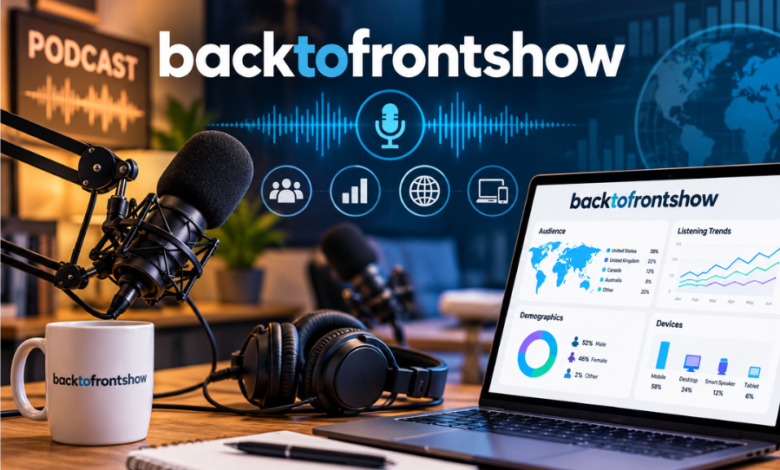
The present-day BacktoFrontShow website instead describes an analytics service for podcast publishers. It advertises demographic insights, engagement measurement, device information and reports, alongside monthly paid plans. A separate US-domain site publishes educational articles.
These descriptions should not be merged into a single company history. A shared name does not establish common ownership. No clear public account documents a transition from the original podcast to the analytics operation.
A Podcast Rooted in the Early Web-Industry Community
The established programme dates to January 2013 in the Listen Notes catalogue. Its central idea was broad but recognisable to digital professionals: discuss what happens behind websites, as well as the design and technology experienced by their users.
Topics moved between interfaces, back-end systems, client work, publishing, conferences and business decisions.
SoundCloud describes informal conversations about technology news, typically lasting 40 to 50 minutes. The discussions drew on professional experience rather than following a classroom-style course.
A June 2016 Shopify article included the show among podcasts worth hearing for web designers. This recognition offers firmer evidence of its place in the community than unsupported audience claims.
The timing matters. Web designers were facing rapidly evolving tools, new expectations from clients and expanding opportunities in ecommerce. A programme led by practitioners could put these changes into conversational context, explaining not just what was fashionable but why a particular tool or trend deserved attention. That approach helped distinguish industry discussion from simple product promotion.
The Voices Behind the Microphones
Keir Whitaker brought experience in web development, publishing and the Shopify partner ecosystem. A 2017 professional biography describes work with Viewport Industries and Shopify partner education.
Kieran Masterton was identified in historical programme materials with the business 88mph. Their conversations approached industry subjects through experience and disagreement.
Those historical biographies cannot establish the hosts’ employment in 2026, nor do archived show notes establish any role for them at the newer analytics website.
What the Original Episodes Actually Discussed
The notes for episode one offer an unusually clear snapshot of the show’s interests. Subjects included the challenges of writing an online biography, co-working arrangements, static-site generation, a web-design conference and recording equipment. Fixed-gear bicycles also came up.
References to Jekyll and Kirby show an interest in practical website publishing decisions, alongside broader industry culture. These were choices with consequences for publishing speed, maintainability and how much control website owners retained. Revisiting such discussions now offers a useful record of the questions developers were asking before today’s dominant workflows became familiar.
Another archived episode examined what happens when crowdfunding campaigns receive more funding than expected. Later discussions considered Medium’s future and alternative approaches to web education. The show was commentary, not a programming tutorial series.
Interviews That Expanded the Conversation
Alongside its regular discussions, the show produced Back Stories interviews. SoundCloud records conversations with Kurt Elster, Craig Lockwood and Marc Thiele in 2016. A podcast-directory listing also records an interview with Oliver Lindberg in June 2017.
The Lindberg episode explored conferences, editing, writing and pitching. The Kurt Elster listing identifies his work around ecommerce and Shopify, extending the programme’s interest in the commercial life of the web.
The interviews retain value beyond dated software news: creative work and publishing decisions remain relevant. Any technical recommendations, however, need checking against current documentation.
An Irregular Publishing History, Not a Current Weekly Show
The show’s earliest recorded release in Listen Notes is January 19, 2013. Whitaker’s 2017 biography notes a January 2016 return after a year-long hiatus, challenging descriptions of a permanently weekly schedule.
The directory records episodes in 2017 and 2018, followed by an entry titled Retro Tech Rabbit Warren dated December 17, 2020. The directory lists 103 episodes, subject to catalogue changes.
The 2020 entry is the catalogue’s latest listing, not proof of a formal ending. Later dates on archived web pages also do not prove newly recorded episodes.
Listeners should approach it as an archive, not a current weekly programme.
The New Analytics Proposition
The current website markets BacktoFrontShow as analytics beyond download totals. Its advertised workflow has four stages: connect a podcast, collect data, inspect a dashboard and prepare customised reports.
Promoted features include audience geography, demographic profiles, listening behaviour, engagement indicators and device analytics. Other pages mention predictive or AI-driven capabilities, sentiment analysis and external integrations.
These are advertised, not independently demonstrated, capabilities. Marketing alone cannot confirm integration reliability, update frequency or demographic accuracy.
For publishers, attractive charts cannot substitute for well-defined, usable data.
What Podcast Analytics Can Really Reveal
Downloads and listening are not identical events. In open podcast distribution, a file request can be counted without proving that somebody listened to the entire episode. IAB Tech Lab publishes industry measurement guidelines.
Platforms with direct playback information can report different metrics. Apple Podcasts Connect, for example, describes listening and completion information derived from activity on Apple Podcasts. Spotify’s 2026 analytics update defines a play as an episode watched or heard for at least 30 seconds on its platform.
A third-party dashboard must therefore explain which measurements come from which platform, and whether they can be compared. Demographic estimates need clear sourcing and privacy safeguards.
For example, a host might register an episode download while a listening app records only a brief play. Adding those figures together would not produce a reliable count of distinct people. Similarly, geographic location inferred from network information may be less precise than a listener’s actual location. Useful reporting should reveal those limitations rather than conceal them behind a single audience total.
Before treating a claimed retention rate or audience profile as decisive, publishers need to know exactly what it measures.
Advertised Pricing and the Questions Behind It
At the time of review, the analytics website displayed a Basic plan at $1,200 per month and Pro at $3,600 per month. Enterprise customers were directed to request pricing. They are advertised prices, not evidence of customer purchases.
Basic lists demographics, engagement monitoring and support. Pro advertises behavioural and device analytics, sentiment analysis and API integration. Enterprise adds custom reporting, account management and white-labelling.
The home and pricing pages present some entitlements differently. Buyers should request a written scope, working demonstration and contract terms.
At these advertised monthly amounts, the business case would need to be specific. A publisher might value reliable campaign reporting or consolidated performance data, but only if those insights cannot already be obtained adequately from its host and distribution platforms. A trial should establish what decisions the additional information actually changes.
A prominently displayed free-trial invitation should likewise not be mistaken for confirmation of an unrestricted self-service trial. The site’s access page describes an application and approval process.
Why Evidence Matters More Than Marketing Statistics
The analytics website’s company description makes ambitious numerical statements about data processing, customer satisfaction, reach and feature development. Some figures presented in different sections use notably different scales for data points analysed.
Without published methodology or independent case studies, these are promotional claims, not established benchmarks.
That does not prove illegitimacy. It does mean asking where data originates, whether claims can be reproduced and how integration failures are handled.
Connecting accounts also requires clear authorisation, retention policies and access limits.
Another BacktoFrontShow Is an Information Website
A separate US-domain site uses the BacktoFrontShow name for a publication about podcasts, recording tools, marketing and statistics. Its own FAQ explicitly says it is an informational website rather than a podcast-hosting platform or a provider of podcast-production services.
It identifies BK Firuz as founder and says it operates from Bangladesh for primarily American readers. This does not establish connections to the other projects.
An educational article is not documentation for commercial software, just as an archived podcast does not prove a supported subscription.
Another similarly named blog describes a conversational podcast and interviews, adding to the ambiguity. Its self-description alone does not verify a connection with Whitaker and Masterton’s programme. Readers should regard names, imagery and broad claims of podcast expertise as starting points for research, rather than as proof that different outlets belong to the same organisation.
How to Make Sense of the Name Before Taking Action
Listeners can identify genuine recordings through host names, episode titles and dates on SoundCloud or established directories. Software advice in old recordings needs updating.
Buyers should request a demonstration, supported-source list and precise metric definitions. Confirm renewal, cancellation, export and support terms in writing.
Readers of the informational site should assess individual articles for accuracy and currency.
A shared online name is not evidence of shared ownership. That distinction matters for both archives and expensive software purchases.
Conclusion
Backtofrontshow has a documented history as a web-industry podcast hosted by Keir Whitaker and Kieran Masterton, with recordings spanning several years. Today, the name also appears on a website advertising podcast analytics and on a separate educational publication.
Their relationship is not publicly established. The original programme remains notable for its conversations about the changing web, while the newer commercial claims deserve independent verification before any purchase. Keeping those identities distinct is the clearest way to understand what backtofrontshow means.
FAQs
What was the original Back to Front Show about?
It was an English-language podcast covering web development, design, online publishing, startups and professional life in the technology industry. Keir Whitaker and Kieran Masterton hosted informal discussions and interviews. Historical episode records and podcast directories document the format and subjects, which ranged from technical tools to conferences and business decisions.
Is backtofrontshow still releasing podcast episodes?
The latest episode shown in the Listen Notes catalogue reviewed is dated December 17, 2020. That makes the original show best approached as an archive. There is no verified regular release schedule for 2026, and a newly dated website page containing old episode notes should not be mistaken for a new recording.
Is the analytics platform the same business as the podcast?
That connection has not been reliably established by the available public material. The original programme identifies two named hosts, while the present-day commercial website promotes analytics plans without clearly explaining an organisational transition. Treat the podcast and the analytics offering as distinct identities unless direct evidence demonstrates otherwise.
How much does BacktoFrontShow analytics cost?
Its current website advertises $1,200 per month for Basic and $3,600 per month for Pro, with Enterprise pricing available on request. These are published asking prices, not verified completed purchases. Anyone considering the service should confirm pricing, features, cancellation conditions and actual access before providing payment details.
Can BacktoFrontShow reveal exactly who listens to a podcast?
No analytics service should be assumed to identify every individual listener. Data depends on hosting records, playback platforms, consent and privacy restrictions. Download estimates, platform-specific plays and demographic information measure different things. Ask any provider to explain the sources and limitations of its reporting rather than relying on an all-encompassing audience claim.