
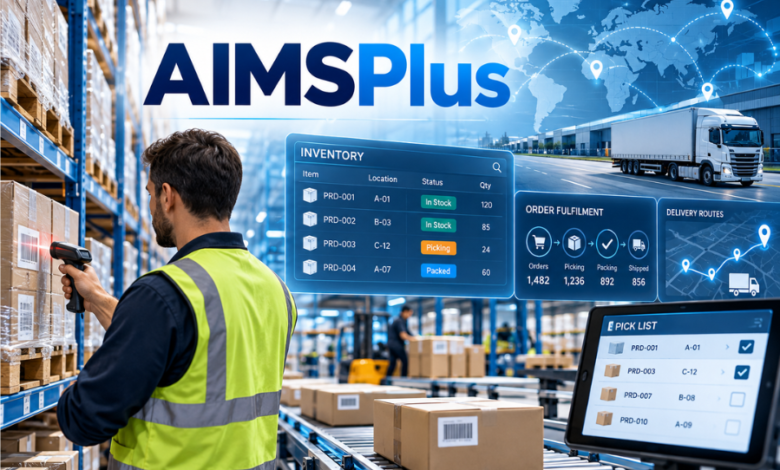
AIMSPlus is a warehouse management and supply chain software platform associated with Atlanta-based Tellworks Logistics. Its purpose is practical: help businesses know what stock they hold, where it sits, how orders are progressing and when goods should move. Rather than treating receiving, inventory, fulfilment and transportation as isolated jobs, the platform connects those activities through operational data and digital workflows.
That makes AIMSPlus particularly relevant to organisations managing complex distribution networks, field equipment or time-sensitive deliveries. Its order-management application also gives authorised customers and contractors tools for scheduling collections and confirming receipt. Here is how the technology works, where it came from, what has been demonstrated in practice and what businesses should establish before considering it for their own operations.
Why Warehouse Visibility Matters More Than Another Dashboard
A warehouse can contain the right products and still fail a customer. An inaccurate stock record, misplaced pallet or missed collection slot can delay an entire project. The underlying problem is often not storage capacity but coordination between purchasing teams, warehouse staff, carriers and the people waiting for goods.
A warehouse management system, or WMS, creates a structured record of goods as they arrive, move and leave. AIMSPlus extends that approach into order visibility and transportation.
For UK and US businesses, the same questions apply regardless of location. Can an employee identify a particular item? Can a manager distinguish available inventory from allocated stock? Can a contractor see whether a pickup is ready?
The Tellworks Connection Behind AIMSPlus
Tellworks Logistics began operating in 2005, initially addressing reverse-logistics needs in the US telecommunications sector. Tellworks subsequently expanded its services into forward logistics, warehousing and transport management.
The company identifies AIMSPlus as its proprietary warehouse management technology. The software is therefore best understood in the context of a logistics operator solving recurring operational problems, rather than as an unrelated consumer application. AIMSPlus also maintains its own software presence and describes solutions for both warehouse operations and wider supply chain planning.
Both organisations are based in Atlanta, Georgia. AIMSPlus identifies Bruce Pilling as chief executive, Chris Clark as its chief information and strategy leader, and Todd Wiegand as chief technology officer. Its leadership page also names Christo Makrides and Jared Krumper as partners.
From Delivery Bay to Reliable Inventory Records
Receiving and Put-Away
The first test of any inventory system comes when goods reach the warehouse. AIMSPlus describes receiving functions built around machine-readable licence plate numbers, handheld scanning and standardised labels. Workers can capture quantities, serial numbers or lots, then direct goods towards an appropriate storage location.
A licence plate number identifies a handling unit within the software’s workflow. That is useful when a shipment contains numerous products or when similar-looking equipment must be distinguished. It should not automatically be confused with GS1’s globally standardised Serial Shipping Container Code; organisations should confirm how their existing identification standards map into the platform.
As with any scanning system, however, the quality of the record still depends on disciplined receiving procedures and accurate initial data.
Counting, Locating and Controlling Stock
Once products have been stored, managers need answers at two levels: how much is available overall and what has happened to an individual item. AIMSPlus positions its inventory tools around both aggregate stock oversight and detailed product tracking, including status and order associations.
Its published capabilities include capacity analysis, warehouse utilisation reporting and automated drone-based cycle counting. These functions address different problems. Capacity reports inform storage decisions, while cycle counts compare recorded inventory against what is physically present. Whether drone counting is suitable or deployed in a particular facility requires a separate technical assessment.
Location layouts, labelling quality, exception handling and regular reconciliation remain essential. Technology can expose discrepancies sooner; trained operational teams must still resolve them.
How Orders Become Pickups and Shipments
Customer-Facing Order Management
The order-management component connects warehouse activity with people who need equipment. AIMSPlus describes desktop and mobile tools for checking order status, arranging pickups, acknowledging receipt and raising issues. Management users can monitor progress and identify potential fulfilment risks.
A telecommunications contractor awaiting parts for a site installation needs a dependable collection appointment, not simply confirmation that a warehouse owns the equipment. Connecting authorisation, scheduling and acceptance helps reduce uncertainty between those events.
Picking, Packing and Dispatch
Behind the customer interface, warehouse teams must assemble the right goods efficiently. AIMSPlus advertises support for piece, batch, zone, cluster and wave picking, alongside packing and kitting workflows.
The platform also describes analytics and AI-assisted optimisation within these processes. Such tools can inform picking sequences or identify inefficient movement, but outcomes depend on configuration and reliable transaction records. Businesses evaluating the system should request measurable performance results relevant to their own order profiles rather than assuming one method will suit every operation.
Planning Before Orders Arrive and Tracking After They Leave
AIMSPlus also promotes demand planning, using historical activity, seasonal patterns and other inputs to inform stock decisions. Its proposition is to connect forecasting with receiving and inventory management so buyers can assess potential shortages or excess stock earlier.
Promotional events, disrupted suppliers and unusual customer demand can defeat even sophisticated models. The meaningful question is whether planners can review assumptions, correct inputs and act on the results before service levels deteriorate.
At the outbound end, the software describes shipping features such as truck-space optimisation, third-party logistics integration and shipment status updates. Its transportation tools include multi-stop routing, truck scheduling and live tracking, with access tailored to internal employees or external stakeholders.
However, not every deployment automatically includes every transport feature or integration. Compatibility, data exchange and implementation scope should be established during procurement.
What Tellworks’ Published Results Actually Show
An important milestone came in November 2020, when Tellworks launched its AIMS+ Order App under the leadership of Chris Clark. The company described the launch in April 2021, explaining that customers could arrange prioritised pickups, acknowledge goods and access fulfilment information on desktop or mobile devices.
Tellworks said that, at the time, approximately 75–80% of customer orders were being scheduled through the app. It also compared March orders: those scheduled through the app spent an average of seven days on hand before collection, against 15 days for manually scheduled orders.
Those numbers offer a useful illustration of the problem the application was designed to address. They are historical figures supplied by the operator, however, not independently audited evidence of a universal saving. Differences in order types and processes may also influence collection times.
In another 2021 account, Tellworks described using AIMSPlus and Tableau to monitor service-level agreements and operational indicators across its market staging locations. The company then referred to 47 US locations. That figure describes its network at that time and should not be presented as a verified current footprint.
Who Uses the AIMSPlus App?
The application is designed around different operational responsibilities rather than unrestricted public access. Its help centre includes guidance for project managers, construction managers, general contractors, technician managers, field technicians, subcontractors and staff at market staging locations.
A project manager may need broad visibility across sites and orders, whereas a field technician may chiefly need collection details. Role-specific permissions can keep an interface relevant while limiting unnecessary access to operational records.
Users seeking access should follow the account process provided by their organisation or Tellworks contact. The official support material describes requesting an account, accessing the help centre and submitting tickets through the application. A public marketing page should not be mistaken for an open sign-up service available to any individual.
Its published FAQ also explains that inactive accounts may be deactivated after 30 days and that passwords are subject to periodic changes.
Automation Ambitions Versus Proven Deployment
AIMSPlus describes ambitions involving robotics, conveyors, autonomous inventory drones, machine learning and advanced warehouse-space modelling.
Yet a product feature described on a company website is not necessarily installed in every customer warehouse. Robotics requires compatible physical equipment, site design and safety procedures. Predictive analytics requires dependable history and sensible assumptions. Drone inventory checks need suitable facilities and processes for dealing with exceptions.
The strongest way to assess these claims is to distinguish existing functionality, optional integrations, pilot projects and future development. Demonstrations and references from comparable deployments can provide much more useful evidence than a broad promise of artificial intelligence.
What Buyers Should Check Before Choosing the Platform
The publicly available product pages explain AIMSPlus functions but do not establish a universal subscription price, implementation cost or standard contract package. A business considering the software should therefore request a tailored proposal and confirm exactly which modules, integrations and support arrangements are included.
Start with the operational baseline. Measure present inventory accuracy, stock dwell time, pickup punctuality, order errors and labour effort. Without reliable starting figures, even a successful rollout is difficult to evaluate objectively.
Next, examine integration with enterprise resource planning, purchasing, carrier systems and existing barcode processes. Ask how permissions are assigned, how audit records are retained, what happens during connectivity failures and how historical data will be migrated. UK organisations should also investigate applicable data-protection obligations and the location of any personal data processing.
Finally, test the product with real workflows: a partial receipt, a missing serial number, an urgent order, a rejected pickup and a returned item.
Conclusion
AIMSPlus matters because warehouse performance depends on the continuity of information from inbound receipt to final handover. Its relationship with Tellworks Logistics gives the software a clear operational setting, while its inventory, order and transport functions address problems that can otherwise become disconnected across teams.
Published deployment examples show why collection scheduling and inventory visibility deserve attention, although older company figures should not be treated as current guarantees. For potential adopters, the sensible measure of AIMSPlus is straightforward: whether its verified capabilities improve the accuracy, timeliness and accountability of their specific supply chain.
FAQs
What is AIMSPlus software used for?
AIMSPlus supports warehouse management and supply chain operations. Its advertised functions include receiving, inventory control, order management, picking and packing, demand planning, shipping and transportation coordination. The precise features available to a particular business depend on the services and integrations included in its implementation.
Is AIMSPlus part of Tellworks Logistics?
Tellworks Logistics describes AIMSPlus as its proprietary warehouse management technology, and the organisations share an Atlanta business address. AIMSPlus maintains its own software website and leadership information. The relationship is clear at an operational level, but readers should not infer an independently verified corporate ownership breakdown from those descriptions alone.
How do I log in to the AIMSPlus app?
Use the access instructions issued by your employer, project administrator or authorised Tellworks representative. The application supports role-based accounts and provides a help centre for assistance. If an account is inactive or credentials no longer work, use the official support process rather than entering details into an unfamiliar website.
Does AIMSPlus use artificial intelligence?
The company describes AI and machine-learning applications in areas such as picking efficiency, demand analysis and warehouse optimisation. It also discusses robotics and automated inventory counting. These statements should not be interpreted as proof that every customer receives or uses all those technologies; deployment details require confirmation.
How much does AIMSPlus cost?
A standard public price is not established on the product pages reviewed. Costs may depend on warehouse requirements, selected modules, integration work, support and the implementation arrangement. Organisations should ask for a written quotation that separates initial setup, ongoing charges and any additional services before making a comparison.


