Repmold is one of those internet terms that sounds like a defined technology before you look closely at the evidence. In 2026, the name is used mainly for Repmold.com, a broad publishing website, and as an informal label for mould replication, rapid tooling, 3D scanning and digital manufacturing. Repmold.com itself describes the term as an advanced mould-making technology, but recognised technical sources do not establish “Repmold” as a standard manufacturing process, machine, material or software platform.
That distinction is central: the documented website should be separated from the real industrial methods sometimes grouped under the Repmold name.
What Is Repmold?
The clearest verified use of Repmold is Repmold.com. Its About page presents the site as a publishing community where writers can contribute articles across a wide range of subjects. The site currently displays categories including technology, business, health, home and garden, travel and general blog content. It also invites guest contributions rather than presenting itself as the corporate website of an identifiable manufacturing business.
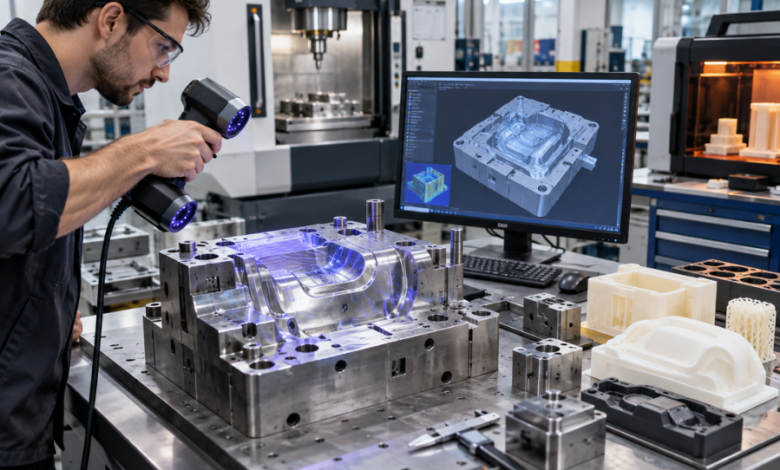
A growing number of web articles also use “Repmold” for a modern mould-making or replication workflow involving rapid prototyping, CAD, CNC machining, additive manufacturing, 3D scanning, reverse engineering or low-volume tooling.
Those technologies are real. The difficulty is that Repmold does not have a single technical definition that tells an engineer exactly which equipment, material, process parameters or quality standard are required. Some sites describe it as a complete manufacturing system; others treat it as a general approach to reproducing moulds or parts. That inconsistency is a strong reason to use the term cautiously.
Why the Repmold Definition Has Become Confusing
Repmold is unusually easy to misunderstand because the word itself sounds plausible. “Rep” can suggest replication, reproduction or rapid production, while “mold” immediately places the term in a manufacturing context.
That does not, however, make it an established industry term. There is a difference between a descriptive internet label and a formally recognised manufacturing process. Injection moulding, compression moulding, rotational moulding, CNC machining and additive manufacturing have established technical meanings. They can be discussed through known equipment, materials, operating conditions, standards and engineering literature.
Repmold currently lacks that level of technical consistency. One article may present it as a rapid-tooling method, while another describes an AI-assisted production system. A third may focus on digital mould replication. Without identifiable specifications, a standard, a manufacturer or validated documentation, those descriptions should not be blended into one supposedly universal technology.
The ideas associated with Repmold can be real even when the label itself is not a recognised process.
The Real Technologies Commonly Linked With Repmold
3D Scanning and Reverse Engineering
When a company needs to reproduce an existing component but lacks a reliable CAD model, 3D scanning can be used to capture the geometry of a physical object. That scan data can then support reverse engineering, inspection or redesign.
NIST has long documented the use of three-dimensional imaging systems in applications including reverse engineering and the generation of 3D models. More recent engineering work also shows how scanning, CAD reconstruction and manufacturing simulation can be combined when reproducing physical components.
This is one of the most credible ideas behind Repmold-style descriptions. A damaged, legacy or undocumented part can be measured, digitally reconstructed and prepared for a new manufacturing route. The process is real even if “Repmold” is not the formal technical name for it.
CAD and Digital Mould Design
Computer-aided design sits at the centre of modern tooling. Once geometry has been captured or created, engineers can refine dimensions, add draft angles, account for shrinkage, design parting lines and plan how a mould will open, fill and cool.
Digital design allows revisions before expensive tooling is committed. Even a small component change can affect manufacturability, wall thickness, finish, ejection and material flow.
In practical terms, this is why digital workflows can shorten development cycles. The value comes from the ability to inspect and modify the design before production, not from the Repmold label itself.
Additive Manufacturing and Rapid Tooling
Additive manufacturing is another established field frequently associated with Repmold. NIST research describes additive manufacturing as a family of processes that build parts from digital models and has examined its use across advanced manufacturing applications. NIST’s 2026 photopolymer additive-manufacturing workshop report also reflects the maturity and continuing development of the field.
Rapid tooling is a related concept. Wohlers Associates describes it broadly as methods or technologies used to produce tooling quickly, with additive manufacturing playing an important role in many rapid-tooling approaches.
For prototypes and shorter runs, rapid tooling may reduce the time and cost of reaching moulded parts. Long production runs may still favour conventional machined tooling where durability and tool life are critical.
CNC Machining and Conventional Toolmaking
Digital manufacturing does not replace conventional machining. CNC equipment remains central to mould and die production because many tools require accurate metal cutting, drilling, finishing and surface preparation.
A digitally designed mould may still end up being machined from aluminium or steel. Additive manufacturing may be used for an insert, prototype or pattern rather than the entire tool. The most effective route depends on the production volume, part geometry, material, tolerance, finish and economics of the project.
Real mould production is often a chain of technologies rather than one all-purpose method, another reason Repmold should not be treated as a fixed process.
Is Repmold the Same as Remold or Remould?
No. The spelling matters.
“Remould” is a recognised British English word, while “remold” is the American spelling. Cambridge defines remould as changing the shape or character of something, and it also has a tyre-related meaning in British usage. Collins likewise identifies “remold” as the US spelling of “remould”.
Repmold is different. The extra “p” makes it a separate term, not a standard alternative spelling.
This distinction matters for search intent. Someone typing “repmold” may be looking for the website, may have encountered the term in an article about manufacturing, or may simply be trying to understand whether it is a recognised word. Someone searching “remold” or “remould” is usually looking for the ordinary English verb or, in British usage, the tyre-related noun.
What Repmold.com Actually Publishes
Repmold.com is not organised like a specialist engineering manufacturer. Its own pages describe a general publishing platform built around guest contributions, and its archive contains articles across unrelated categories.
That context is important because the site also hosts an article describing Repmold as an advanced mould-making technology focused on speed, accuracy and cost efficiency. The article makes broad claims about manufacturing applications, including automotive, medical, aerospace and consumer goods.
Those claims should be read as content published by the website rather than as independent proof that a recognised industrial system called Repmold exists. The site does not, on the public pages reviewed, identify a manufacturing facility, product catalogue, technical specification, named engineering team or formal standard that would establish Repmold as a proprietary industrial platform.
The safer interpretation is therefore two-layered: Repmold.com is a real multi-topic publishing website, while “Repmold” as a manufacturing term remains loosely defined online.
Where Repmold-Style Workflows Could Be Useful
Even without treating Repmold as a formal technology, the underlying workflow can make sense in several manufacturing situations.
One is legacy-part reproduction. If an older component is no longer supported and original CAD data is missing, engineers may scan the part, rebuild its geometry, correct wear or damage, and manufacture a replacement through machining, printing or moulding.
Another is prototype development. A team may need moulded samples before committing to expensive production tooling. Rapid tooling can help test fit, function, material behaviour and assembly earlier in the development process.
Low-volume and customised manufacturing may also benefit from flexible tooling methods. When production quantities are limited, the cost of a high-volume steel mould may be difficult to justify. A faster or simpler tooling route can sometimes provide a better commercial balance.
These are established engineering decisions. Their suitability depends on tolerances, materials, expected tool life, regulatory requirements, inspection needs and total cost.
What Repmold Is Not
Repmold should not automatically be described as a patented technology, an AI platform, a specific machine, a proprietary material or a globally standardised manufacturing method.
Those claims require evidence such as patent records, product documentation, technical manuals, company filings, validated case studies or recognised standards. The current public record is not strong enough to support them as general facts.
It is also misleading to suggest that every process involving 3D printing, scanning or rapid tooling is “Repmold”. Those technologies already have established names and should be identified accurately.
For manufacturers and buyers, the practical question is not whether a supplier uses a fashionable label. It is which actual process will be used, what material will be produced, what tolerances can be achieved, how quality will be checked and whether the method is appropriate for the intended production volume.
How to Evaluate a Repmold Claim
When the word appears on a manufacturing or technology website, look for details rather than marketing language. A credible technical claim should explain the equipment, workflow, materials and measurable performance.
Ask whether “Repmold” means 3D scanning followed by CAD reconstruction, additive manufacturing of tooling, CNC-machined moulds, silicone casting, injection moulding or another known process. If a provider cannot define the method clearly, the label itself adds little value.
The same principle applies to claims about speed, sustainability or lower cost. Faster tooling may reduce development time in some cases, but no process is automatically faster or cheaper for every part. Material choice, geometry, batch size, machine capacity, finishing, inspection and tool life all affect the result.
Conclusion
Repmold is best understood through context, not hype. The name is clearly used by Repmold.com, a general publishing and guest-contribution website, while its manufacturing meaning remains informal and inconsistently defined. The industrial ideas connected with it—3D scanning, reverse engineering, CAD, additive manufacturing, rapid tooling and CNC machining—are genuine and important technologies, but they already have established technical identities.
For anyone researching Repmold, the most reliable approach is therefore to separate the label from the process. Focus on what technology is actually being used, what evidence supports the claims and whether the method is suitable for the required part, material, tolerance and production volume.
FAQs
What does Repmold mean?
Repmold currently has no single standard technical definition. It is used online as the name of Repmold.com and as an informal label for ideas involving mould replication, rapid tooling, reverse engineering and digital manufacturing. The meaning depends on where the term appears.
Is Repmold a real manufacturing technology?
The technologies often connected with Repmold are real, including 3D scanning, CAD, CNC machining, additive manufacturing and rapid tooling. However, Repmold itself is not established in the reviewed authoritative sources as a standardised manufacturing process with one accepted technical specification.
Is Repmold.com a manufacturing company?
Its public About page describes it as a multi-topic publishing community that accepts guest contributions. The public pages reviewed do not establish it as a manufacturing company with a factory, technical product range or documented industrial platform.
Is Repmold the same as 3D printing?
No. Additive manufacturing, commonly called 3D printing, is a defined manufacturing field. Repmold is a much looser term. Some online descriptions connect it with additive manufacturing, but the two should not be treated as synonyms.
Is Repmold the same as remould?
No. “Remould” is the British English form of “remold” and means to shape or form something again. Repmold is a separate spelling that is mainly encountered online as a website name or informal manufacturing label.