
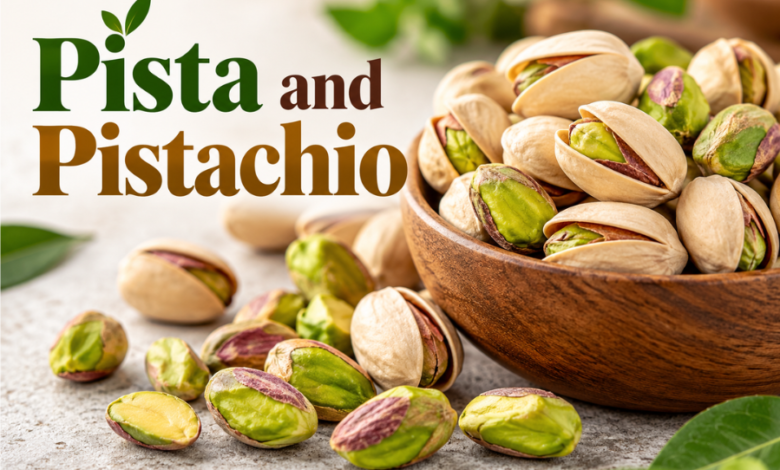
Pista and pistachio are two names for the edible seed of Pistacia vera, a tree cultivated for its distinctive green kernels and delicate, nutty flavour. The word “pista” is familiar across South Asian kitchens, while “pistachio” dominates packaging and menus in Britain and the United States. Despite the different names, neither refers to a separate species or a nutritionally superior product.
The distinction matters when shopping for snacks or ingredients. Origin, variety, roasting and salt can change what arrives in the packet, but the underlying food remains the same. From its Central Asian roots to modern Californian orchards and Sicilian pastry shops, this small seed has an unusually rich culinary story.
Are Pista and Pistachio Actually Different?
The short answer is no. Pista is a common name in Hindi, Urdu and other South Asian languages for what English speakers call a pistachio. Both words describe the edible seed harvested from Pistacia vera, which belongs to the Anacardiaceae family, alongside cashews and mangoes.
A shopper might see “pista” on a packet intended for making barfi or kulfi and “pistachios” on a bag of roasted snacks. That difference reflects the intended market, not a botanical distinction. An unsalted pista kernel can be used wherever a recipe calls for unsalted pistachios.
What can vary is the product itself. Shelled kernels, nuts still enclosed in their hard shells, chopped pieces and sweetened pastes serve different purposes. A bag labelled pista may also have a different country of origin or processing method from one labelled pistachios.
A Seed With Roots in Central Asia
Royal Botanic Gardens, Kew, places the natural range of Pistacia vera from north-eastern Iran through Afghanistan and parts of Central Asia. Its cultivation has a long history, although the precise place and date of domestication remain subjects of academic debate.
Research combining archaeological, genetic and linguistic evidence points towards southern Central Asia as an important centre of early cultivation. The crop later travelled into the Middle East and Mediterranean, where it became part of regional food traditions.
That movement shaped Persian, Turkish, Levantine and Indian desserts. The names changed as the seed crossed borders; its culinary value did not. Today, pistachios remain associated with hospitality, festive cooking and carefully made desserts as well as convenient snacking.
How Pistachios Grow and Reach the Shop
Unlike many familiar orchard crops, pistachio trees have male and female flowers on separate plants. Wind transfers pollen, so productive orchards need suitable male trees alongside fruit-bearing female trees. They favour hot summers and sufficient winter chilling, making the choice of growing region important.
Commercial trees take years to establish. University of California agricultural guidance notes that small crops may begin after five or six years, with full production often coming later. Yields can also alternate between heavier and lighter seasons.
As the seed matures, its hard inner shell often splits naturally, creating the characteristic opening. After harvest, processors remove the outer hull, dry the nuts and sort them. Some are roasted; others are sold raw.
Pistachio Nutrition: What Is in a Handful?
A typical 28-gram serving of plain pistachio kernels provides approximately 160 calories, six grams of protein and three grams of dietary fibre. It also contains roughly 13 grams of fat, predominantly unsaturated rather than saturated fat.
Pistachios supply vitamin B6, thiamin, copper, potassium and other nutrients. Their protein and fibre can make them a satisfying snack.
These figures describe the edible kernels, not the weight of shells. Measuring a portion of in-shell nuts without removing the shells can therefore give a misleading comparison. Nutritional values also differ modestly between raw and roasted products and across brands.
No individual nut supplies everything a balanced diet requires. Pistachios work best alongside vegetables, fruit, whole grains and varied protein sources, rather than as a replacement for an entire food group.
What the Health Research Really Shows
Pistachios have been studied for their effects on cholesterol, blood pressure and blood glucose. Reviews of controlled trials have found improvements in certain cardiometabolic measurements, including modest reductions in systolic blood pressure in some analyses.
That is encouraging, but it does not establish that eating pistachios prevents heart disease or treats diabetes. Individual trials vary in size, duration and dietary conditions, and some outcomes remain inconsistent. What replaces another food in the diet also matters: exchanging heavily salted snacks for plain nuts is different from simply adding extra calories.
The American Heart Association includes unsalted pistachios among suitable sources of healthier fats. A modest handful is a practical portion for many adults, although individual energy needs differ.
Why the Colour and Taste Vary
Fresh pistachio kernels can range from yellow-green to vivid green, often with a purple or brownish skin. Chlorophyll contributes to the green colour, while other natural pigments help create contrasting shades. Variety, ripeness and processing all affect appearance.
Flavour varies too. Some kernels taste sweet and buttery, while others have a deeper roasted character. Salt intensifies a snack’s savoury edge, whereas raw or lightly toasted kernels often suit desserts better.
A brilliant green ice cream is not proof of unusually high pistachio content. Colouring can influence its appearance; the ingredient declaration is a more useful guide to what the dessert contains.
The Kitchens That Made Pista Famous
South Asian Sweets and Everyday Cooking
In India and Pakistan, chopped or slivered pista adds colour and texture to kheer, firni, barfi, halwa and kulfi. It pairs especially well with cardamom, saffron and milk-based desserts. Ground kernels can also enrich fillings, sauces and sweet drinks.
Here, texture is often as important as flavour. Thin slivers offer a delicate finish, while finely ground nuts blend into creamy mixtures. Using unsalted kernels preserves control over sweetness and seasoning.
From Turkish Baklava to Italian Gelato
Across Türkiye and the Middle East, pistachios are central to numerous pastries and confectionery traditions, including certain styles of baklava. Their concentrated flavour balances buttery pastry and syrup without requiring a large quantity.
Italian gelato makers and pastry chefs use pistachio paste for richness and depth. In Sicily, the protected name Pistacchio Verde di Bronte identifies nuts meeting specific geographical and production requirements near Mount Etna. It is a recognised origin designation, not another species.
Roughly chopped kernels bring crunch to rice, salads, roasted vegetables and crusts for fish or poultry, while blended nuts can form the base of sauces and dressings.
Where Pistachios Come From Today
The United States, Iran and Türkiye are major players in the international pistachio trade. California is the centre of American production, with commercial cultivars including Kerman, Golden Hills and Lost Hills. Differences in flowering time, harvesting and shell splitting influence growers’ choices.
US Department of Agriculture figures put the 2025 American harvest at approximately 1.58 billion pounds in-shell, a record at the time. The agency’s February 2026 outlook anticipated a strong US crop alongside reduced output in some other producing countries.
Country of origin can influence size, flavour, colour and price, but nationality alone cannot establish quality. Freshness, grading, careful handling and suitability for the intended recipe matter more than broad claims that one country invariably produces the best nuts.
How to Buy, Use and Store Them Well
Start with the recipe. Unsalted shelled kernels are convenient for baking, garnishing and making paste. In-shell nuts are often better for leisurely snacking, while finely chopped pieces can save preparation time. Check whether “shelled” means the hard shell has already been removed.
For plain snacking, choose unsalted or lightly salted varieties according to dietary needs. Read labels on flavoured products: added sugar, coatings and seasoning can make their nutrition quite different from that of plain nuts. Compare prices by the edible weight rather than the apparent size of the packet.
Store pistachios in a tightly sealed container, away from heat, moisture and strong odours. Refrigeration or freezing can help maintain quality for longer periods, especially for shelled kernels. Nuts with an unpleasant rancid smell, visible mould or unusual deterioration should be discarded.
Allergies and Other Safety Considerations
Pistachios are tree nuts and can trigger serious allergic reactions. Their allergenic proteins can also cross-react with those found in cashews. Anyone with a diagnosed nut allergy should follow advice from their allergy specialist and check packaged-food labels carefully.
Whole nuts are also a choking hazard for young children. NHS guidance advises against giving whole nuts to children under five; properly crushed or ground nuts may be appropriate when introduced safely during weaning, taking allergy guidance into account.
Food safety begins long before the packet is opened. Pistachios are among the crops susceptible to aflatoxins produced by certain moulds. Regulators monitor contamination, and reliable processing and storage reduce risk. Consumers should buy from reputable suppliers rather than assume that home roasting can make spoiled nuts safe.
The Farming Challenge Behind Every Kernel
Pistachio trees tolerate dry conditions, but commercial orchards still require careful water management. Climate, irrigation infrastructure and agricultural practices determine their environmental impact; drought tolerance does not make a crop water-free.
Growers face pests, fluctuating yields and changing weather. Breeding and orchard research aim to improve harvest timing and the share of nuts that develop usable, naturally split shells.
Conclusion
Pista and pistachio are the same seed, carrying different names through connected food cultures. Their appeal lies in a combination of flavour, texture, useful nutrients and remarkable versatility. Choosing the right form, checking salt and added ingredients, and storing kernels properly matter far more than which name is printed on the packet. Whether scattered over kulfi or eaten as a simple snack, pistachios reward attention to quality and portion size.
FAQs
Is pista the same as pistachio in English?
Yes. Pista is a widely used South Asian name for the pistachio, the edible seed of Pistacia vera. The difference is linguistic, not botanical. When buying either product, check whether it is raw, roasted, salted, shelled or processed into a paste, since those distinctions affect how it can be used.
Are pistachios good for weight management?
They can fit into a balanced eating pattern because they contain protein, fibre and unsaturated fats. However, they are energy-dense, so portion size matters. Research does not justify treating pistachios as a weight-loss remedy. Replacing less nutritious snacks with a measured handful is more sensible than adding unlimited quantities to an existing diet.
Can people with diabetes eat pista?
Plain, unsweetened pistachios can be included in many diabetes-friendly meal plans. Their combination of fat, fibre and protein differs from that of sugary snacks. Nevertheless, portion sizes and the overall meal remain important. Anyone managing diabetes should follow individual dietary guidance rather than depend on pistachios to control blood glucose.
Is green pista better than yellow pistachio?
Not necessarily. Natural kernel colour depends on variety, growing conditions, maturity and processing. A greener kernel may be desirable for decorating desserts or producing an attractive paste, but colour alone does not prove superior nutrition or freshness. Aroma, taste, storage conditions and product quality are more dependable buying considerations.
How many pistachios should you eat each day?
For many adults, about 28 to 30 grams of edible kernels makes a reasonable snack portion, providing approximately 160 to 170 calories. There is no single compulsory daily quantity. Needs vary with age, activity, total diet and medical circumstances. Choose plain varieties when possible, and avoid pistachios altogether if an allergy makes them unsafe.
