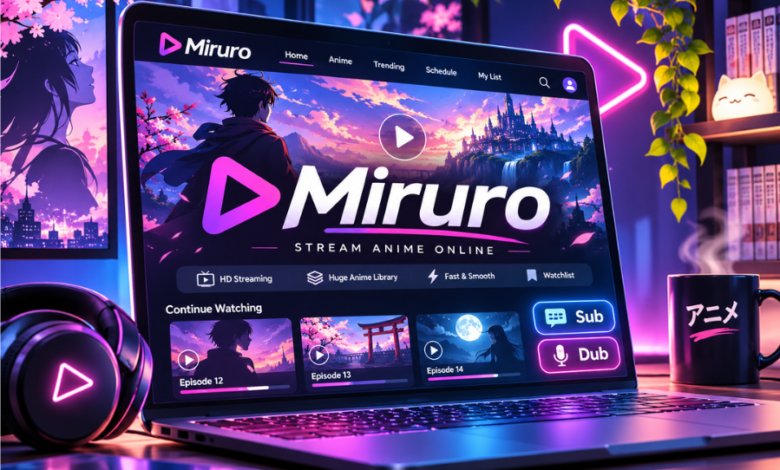
Miruro is a free anime streaming website that promotes high-definition viewing, subtitled and dubbed episodes, and access without creating an account. Its appeal goes beyond its catalogue: the platform combines anime discovery, viewing controls and tracking tools in an interface designed for regular viewers.
Yet its changing web addresses and dependence on outside video providers raise practical questions about reliability, privacy and copyright. In October 2026, Miruro directed users towards a new primary domain while discussing changes to its account and viewing experience.
For anyone encountering the name through search results or recommendations, the important questions are straightforward. What does Miruro actually provide, which features are useful, and how should its convenience be weighed against the uncertainties surrounding unofficial streaming?
Why Miruro Has Attracted Anime Viewers
Anime fans often follow several series at once, making it difficult to track programmes scattered across services.
Miruro attempts to simplify that experience through a single discovery and playback interface. Its public description emphasises free access, full-HD viewing where available, English subtitles and dubbed options. Visitors can explore titles without first completing a registration form.
The appeal is straightforward: fewer registration barriers and no subscription price. However, a broad catalogue does not establish that every programme is licensed.
Miruro is better understood as an unofficial anime-access platform than as a conventional licensed streaming business. That distinction matters when evaluating its stability, security and relationship with the wider anime industry.
How the Website Organises Discovery and Viewing
The interface places anime titles at the centre of the experience, with areas for trending programmes, popular selections and airing schedules. Rather than requiring visitors to know a particular title in advance, these sections provide routes into unfamiliar series and current discussions.
Programme pages help viewers reach episodes quickly, although playback depends on the available source.
Subtitles, Dubs and Picture Quality
Miruro advertises both Japanese-language anime with subtitles and versions featuring English voice performances. That accommodates different viewing preferences and screen sizes.
Availability is not necessarily identical across series or episodes. Community discussions have described occasions when a title’s dub label did not match the available audio, or when particular subtitle formats were missing.
Those options are not guaranteed for every episode. Hard subtitles are embedded in the video image, whereas selectable, or soft, subtitles can often be switched or adjusted in a player.
The distinction matters to viewers who need particular caption sizes or want to alternate between dubbed and original-language audio.
Likewise, actual resolution varies by source, connection and device; HD labels do not guarantee smooth playback.
Player Controls and Customisation
The service also promotes a customisable interface. For frequent viewers, seemingly minor elements such as navigation, episode selection and player settings can influence whether an experience feels convenient or frustrating.
October community updates described additional hard-subtitled episodes and an optional real-time Anime4K upscaling setting intended for sufficiently capable computers.
Upscaling may alter perceived image sharpness, but it cannot recreate detail that is absent from a poor source. Such features may also behave differently between versions of the website.
Such anime-specific controls help explain users’ interest despite inconsistent playback.
The Tracking Feature That Changes the Experience
Miruro addresses forgotten episode progress through local viewing history and AniList integration.
According to the platform’s domain announcement, guest viewing history is stored within the browser on the user’s device. This avoids a Miruro account but has limitations.
A history saved on one domain does not automatically appear when a viewer changes to another. Clearing browser data, changing devices or using a different browser can also disrupt locally stored progress.
This is particularly relevant while addresses are changing. Private browsing sessions may also discard local history when closed, making guest progress especially vulnerable to being lost.
AniList integration offers a more portable way to keep track of watched episodes and lists. Miruro has recommended using an AniList sign-in when moving between its domains.
Users should still examine any permissions requested during authentication and understand what an external connection can access.
Community updates also described intermittent MyAnimeList sign-in problems linked to rate limits. Keeping an independent watchlist remains useful.
Why the Miruro Domain Situation Changed in 2026
For many readers, the most confusing part of Miruro is not its player but its identity online. The project has operated through several web addresses, leaving older recommendations and bookmarked pages potentially out of date.
Its official domain index now identifies the .cx address as the primary destination. An announcement on that version says users of older addresses may be redirected and that unlisted domains are being phased out.
The index also identifies a separate version labelled 2.0 and an associated project called Anivault.
Familiar branding cannot prove who operates a website. Search results may contain outdated addresses or impersonators.
A new web address also makes it harder to judge search rankings: a prominent result is not necessarily the current project destination. The project advises checking its own domain index for changes.
Its announcement also says work is under way on an optional account system intended to preserve watchlists across devices and official domains. That proposal should not be mistaken for a completed, universally available feature.
Domain changes may also disrupt local history and create uncertainty about sign-in pages.
Service Disruptions and the Reality of Third-Party Playback
Miruro’s apparent convenience depends partly on video delivery arrangements outside the viewer’s control.
Earlier versions of its website stated that media files were not stored directly by the platform and that content was accessed through third-party services.
A polished interface cannot prevent streams from failing, loading slowly or lacking particular audio options.
October 2026 community discussions included reports of errors, inaccessible episodes and mobile-browser controls that did not behave as expected.
Other users reported that the site worked for them. Those experiences suggest uneven reliability, not a universal outage affecting everyone.
Problems can originate with providers, browsers, connections or website versions; changing domains is not a universal fix.
An aggregator cannot guarantee the quality or continuing availability of outside streams.
Is Miruro Safe to Use?
A secure-connection symbol cannot verify a site’s operator, advertisements or content rights. Encryption only protects data in transit.
Miruro markets itself as privacy-focused and says registration is unnecessary. Those are useful claims to consider, but they do not amount to an independent privacy or security audit.
External video hosts, embedded components and any sign-in integrations may introduce additional data-sharing considerations.
Copycat sites can exploit familiar branding to seek passwords, downloads or payments. Treat browser warnings seriously.
For general online safety, avoid installing unexplained browser extensions or media players, do not reuse important passwords, and reject suspicious downloads.
Keep the browser and operating system updated. Do not assume a positive comment or an attractive interface constitutes a technical security assessment.
If a page redirects to an unrelated service or asks for sensitive financial information, leave it.
Precautions reduce risks but cannot guarantee that unofficial video sources are trustworthy.
Copyright Questions Behind Free Streaming
The critical distinction concerns distribution rights. Anime appearing online does not mean the website has permission to stream it.
Miruro has not publicly demonstrated comprehensive licensing agreements covering its advertised catalogue. Consequently, readers should not assume its streams are authorised simply because they are free or accessible without registration.
The issue has attracted industry attention. In August 2026, the Motion Picture Association, acting for the Alliance for Creativity and Entertainment, requested information from Cloudflare concerning numerous domains, including several then associated with Miruro.
The request sought identifying information connected to alleged copyright infringement.
That request indicates scrutiny, not a conviction or final judgment.
Legal consequences vary with jurisdiction and the circumstances of access, distribution or operation.
UK government guidance identifies unauthorised online streaming as a copyright concern, while US copyright law also protects rights holders against unauthorised exploitation.
Anyone seeking certainty about a specific activity needs advice relevant to their location.
Licensed platforms offer a clearer arrangement because their catalogues are distributed through agreements with rights holders.
Such agreements help fund the companies involved in production, licensing, localisation and distribution.
Licensed Alternatives Worth Considering
Crunchyroll remains a prominent specialist destination for anime, with subscriptions offering a broad catalogue, simulcasts and viewing features.
It also operates a separate free, scheduled anime channel on certain devices, although that is not the same as unrestricted on-demand access to its premium library.
HIDIVE is another subscription-focused option, particularly for selected simulcasts, exclusive acquisitions and English-dubbed releases.
Its availability and programme selection depend on territory, so a title offered to an American subscriber may not be available in exactly the same way elsewhere.
Tubi provides a different model: legally available, advertising-supported television and films, including an anime category.
Its catalogue contains both dubbed and subtitled titles, but regional licensing and rotation mean availability can change.
Netflix also carries licensed anime alongside its wider entertainment catalogue.
No single legitimate service guarantees every series, and the most practical choice depends on particular shows, location and language preferences.
Checking a specific title before subscribing can prevent paying for a catalogue that lacks the season or dub a viewer expects.
Catalogue rights, accessibility, reliable playback and transparent billing also deserve consideration.
What Miruro’s Next Chapter Could Mean
Domain consolidation and proposed account features could make Miruro easier to use across devices.
None of that resolves the central uncertainty surrounding unofficial anime distribution. Technical improvements cannot substitute for verified rights agreements, while a convenient design cannot guarantee uninterrupted access to outside video hosts.
Streaming quality ultimately depends on reliable delivery, clear identity, data practices and respect for creators.
Conclusion
Miruro stands out for its anime-oriented interface, subtitle and dub options, flexible playback features and viewing-history tools.
Its 2026 domain changes, inconsistent third-party streams and unresolved licensing questions are equally important parts of the picture.
Understanding both sides helps viewers distinguish an attractive streaming interface from the reliability and rights assurances provided by licensed services.
FAQs
What exactly is Miruro?
Miruro is an anime-focused website promoting free access to subtitled and dubbed episodes, high-definition playback and tracking features. It is not equivalent to a major licensed subscription broadcaster. Its available streams, video quality and individual features can vary by provider and website version.
Does Miruro require an account?
The platform promotes viewing without registration, and guest history can be stored locally in the browser. AniList integration can help maintain progress across domains or devices. Miruro has discussed an optional account system, but an announced plan should not be treated as a fully launched feature.
Why did Miruro change its domain?
In 2026, the project’s own announcements began directing viewers towards a primary .cx address and warning that older domains could be redirected or retired. Its stated guidance is to consult its domain index rather than trust an unfamiliar search result or a copied logo.
Is Miruro legal in the UK or US?
Copyright law protects anime in both countries. Miruro has not demonstrated comprehensive licences for its catalogue, so users should not presume the streams are authorised. The legal position for a particular activity can depend on the jurisdiction and facts; availability on a website is not proof of permission.
Why are some Miruro episodes not working?
Playback can fail because a third-party video provider is unavailable, a particular server lacks the episode, or a browser or connection encounters a problem. Community reports in October 2026 described mixed experiences, so an error does not necessarily indicate that every version of the website is offline.