
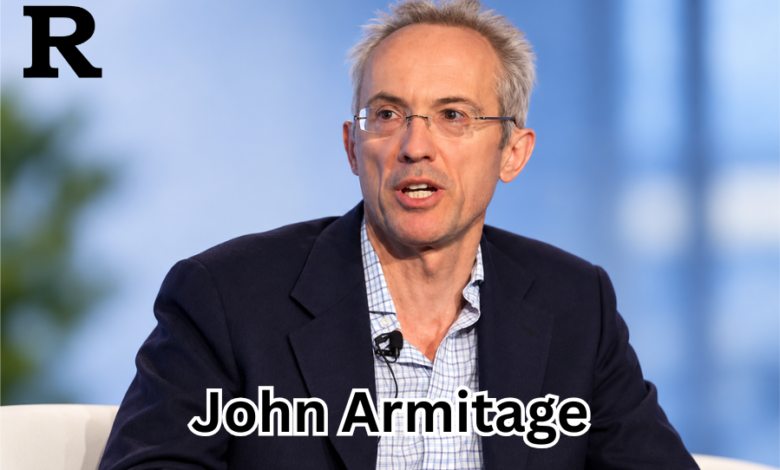
John Armitage has spent more than three decades building Egerton Capital into one of London’s established independent investment firms. The British-born, Irish-citizen billionaire co-founded the business in 1994 and remains its chief investment officer, overseeing strategies that invest in global equities.
By 30 September 2026, Egerton reported $19.4 billion in assets under management, reflecting the scale reached by a firm that began with far less capital.
Yet Armitage’s significance extends beyond its size. His reputation rests on research-led stock selection, willingness to depart from market benchmarks and sustained involvement in portfolio decisions. Understanding his career means examining how Egerton operates, what its public holdings reveal, and why his investment philosophy still attracts attention in a market increasingly shaped by technology and passive funds.
Quick Bio
| Detail | Information |
|---|---|
| Full Name | John Christopher Armitage |
| Known As | John Armitage |
| Date of Birth | 20 December 1959 |
| Age | 66 years (as of October 2026) |
| Birthplace | United Kingdom |
| Nationality | British-born, Irish citizen |
| Profession | Investor, Hedge Fund Manager |
| Education | Pembroke College, University of Cambridge |
| Qualification | Degree in Modern History |
| Known For | Co-founding Egerton Capital |
| Company | Egerton Capital |
| Current Position | Co-founder and Chief Investment Officer |
| Co-founder | William Bollinger |
| Company Founded | 1994 |
| Previous Employer | Morgan Grenfell Asset Management |
| Estimated Net Worth | $2.2 billion (Forbes estimate, 2026) |
| Industry | Finance and Investment Management |
| Professional Base | London, United Kingdom |
A Founder Still Responsible for Investment Decisions
Egerton identifies Armitage as both founder and chief investment officer, with direct portfolio-management responsibilities across its equity long/short and long-only strategies.
Long-only portfolios aim to profit primarily from owning securities that appreciate. Long/short strategies can also take positions designed to benefit when selected securities decline, potentially reducing market exposure. Neither approach eliminates risk.
Egerton describes itself as entirely partner-owned. Its London-based operations are regulated by the UK Financial Conduct Authority, while the firm is also registered with the US Securities and Exchange Commission. These arrangements place a founder-led business within an institutional regulatory framework. Investment Management Firm+1
The European Fund That Established His Credentials
Armitage graduated from the University of Cambridge in 1981 with a degree in modern history, then joined Morgan Grenfell Asset Management that same year.
His early work developed around European company analysis. From April 1988 until March 1994, he managed the Morgan Grenfell European Growth Trust, which ranked among the stronger European equity funds during his tenure. Morgan Grenfell appointed him a director in 1991.
That experience required comparing businesses across different economies and sectors rather than simply following a domestic index. It also established a documented investment record before he founded his own firm.
Founding Egerton subsequently gave him greater control over portfolio construction and the direction of his investment business.
Creating Egerton Capital With William Bollinger
In 1994, Armitage and William Bollinger co-founded Egerton Capital. The firm entered a competitive market, but its proposition was focused: detailed fundamental research and active stock selection rather than ownership dictated by benchmark weightings.
In a 2024 interview featured by Egerton, Armitage discussed starting the business with approximately $10 million. That beginning offers a useful contrast with the multibillion-dollar organisation Egerton subsequently became, although assets managed are not equivalent to profits earned.
Egerton’s partner-owned model keeps control within the business rather than a larger banking group, although independence cannot guarantee returns.
By September 2026, Egerton reported $19.4 billion under management. Its scale demonstrates continued demand for active equity management.
That growth also changes the challenge facing a stock picker: larger portfolios need investment opportunities that can absorb meaningful capital without pushing prices against the manager. Egerton’s stated preference for liquid, large-cap companies addresses that practical constraint.
How Armitage Approaches a Potential Investment
Egerton’s published philosophy begins with individual companies. The firm looks for quality businesses at attractive valuations, meaningful potential upside and securities that can be traded without excessive difficulty.
It also emphasises limited leverage, diversification and awareness of broader economic conditions. High-conviction investing therefore need not mean ignoring liquidity, position sizes or the possibility of error.
In an October 2026 conversation with Nicolai Tangen, chief executive of Norges Bank Investment Management, Armitage discussed pricing power, warning signs that can prompt a sale, and the practice of building positions gradually. Norges Bank Investment Management
Pricing power matters because companies that can maintain prices without sacrificing demand may be better equipped to defend margins against rising costs. Building a position gradually also allows fresh evidence and valuations to inform its eventual size.
Armitage addressed artificial intelligence in that discussion, presenting it as an aid to thinking rather than a substitute for judgement. That view reinforces his emphasis on independent research.
What Egerton’s Recent Holdings Actually Show
Public US regulatory filings provide a partial window into Egerton’s investment choices. Its portfolio disclosure for the quarter ending 30 September 2026 listed approximately $9.8 billion in reportable US-listed long holdings across 23 positions.
Visa and Amazon were the largest reported positions, followed by Amphenol, Nvidia and Moody’s. The mix spans payments, commerce, technology hardware and financial information.
Together, the five largest disclosed positions represented more than half the value of that particular US filing. That concentration supports the description of the firm as selective, while offering no certainty about how the positions will perform. Insider Monkey
The distinction between this filing and Egerton’s $19.4 billion in total assets is essential. A US Form 13F does not describe an entire global investment portfolio.
It generally excludes short positions, cash and many overseas securities, and captures holdings at a past quarter-end rather than continuously. The figures are neither Armitage’s personal investments nor a live record of every Egerton trade.
A Record That Has Attracted Industry Attention
Long-term outcomes have helped establish Egerton’s standing among European hedge funds.
Forbes reported in 2026 that the firm had generated approximately $30.9 billion in net gains since its investment inception in 1995, citing research by Edmond de Rothschild. Those cumulative gains are distinct from assets managed, revenue and Armitage’s personal earnings. Forbes
In 2015, reporting highlighted his bearish positioning against oil and energy shares while others anticipated a rebound. A successful contrarian call, however, says little about returns in other years.
Ultimately, his professional significance rests less on a single trade than on the survival of an active investment process across changing markets.
For prospective investors, past gains still need to be weighed against drawdowns, fees, liquidity terms and the risk that a strategy suited to one environment may struggle in another.
Leadership Beyond One Individual
Although Armitage remains responsible for investment direction, Egerton has a broader management structure.
The firm’s leadership identifies Jeff Blumberg as chief executive officer and Ralph Kanza as chairman, alongside its investment team. Their separate responsibilities make it inaccurate to describe Armitage as Egerton’s CEO.
He additionally remains a director of Egerton Capital Limited and a partner in the firm’s UK and US partnerships.
These responsibilities underline his continuing involvement in both portfolio management and the organisation he helped establish.
Citizenship, Politics and Public Visibility
Born in the United Kingdom on 20 December 1959, Armitage became an Irish citizen in 2018. He continues to be associated professionally with London, where Egerton is headquartered.
The citizenship change attracted attention after the Brexit referendum. Contemporary reporting also documented his support for the campaign to remain in the European Union. However, political views alone cannot establish his motivation for obtaining Irish citizenship.
His public profile also includes political donations. He was a significant Conservative Party donor, including a reported £500,000 contribution during the 2017 general election campaign.
In 2022, parliamentary records disclosed a £12,500 donation supporting Keir Starmer’s office as Labour leader. These contributions document political involvement without establishing a permanent party allegiance. The Irish Times+1
Wealth Estimates and Personal Privacy
Forbes estimated John Armitage’s net worth at approximately $2.2 billion in October 2026 and identified hedge funds as the source of his wealth.
The figure is an external estimate, not an audited statement of his personal finances; valuations can change with market conditions and other information.
Nor should the wealth estimate be confused with money Egerton manages for clients. Client assets do not belong to the fund manager.
Armitage maintains a comparatively limited public profile outside finance. His private family life is less thoroughly documented than his career, making professional achievements a more reliable basis for assessing his public significance.
Conclusion
John Armitage’s influence comes from the unusual combination of longevity, direct investing responsibility and a firm that has remained independent since its 1994 foundation.
Egerton Capital’s scale and reported investment gains highlight the commercial impact of his approach, while stock selection remains central to the business. His professional legacy is therefore defined by sustained investment leadership rather than billionaire rankings alone.
FAQs
Who is John Armitage?
John Armitage is a British-born investor and Irish citizen best known for co-founding London-based Egerton Capital in 1994. He serves as its chief investment officer and manages equity long-only and long/short strategies. His career began at Morgan Grenfell Asset Management in 1981.
How much is John Armitage worth?
Forbes put John Armitage’s estimated net worth at around $2.2 billion in October 2026. It is a published estimate rather than a confirmed personal balance sheet. His wealth should not be equated with Egerton Capital’s assets under management, which represent money managed on behalf of clients.
What companies does Egerton Capital invest in?
Egerton invests primarily in publicly traded global equities. Its September 2026 US regulatory disclosure included major holdings in Visa, Amazon, Amphenol, Nvidia and Moody’s. These filings show only certain reportable long positions at quarter-end and do not reveal the firm’s complete investment exposure.
Is John Armitage still running Egerton Capital?
As of October 2026, Egerton lists Armitage as its founder and chief investment officer, responsible for its equity portfolio strategies. Jeff Blumberg serves as chief executive officer, overseeing a different leadership function. Armitage also holds directorship and partnership roles within the business.
Why did John Armitage become an Irish citizen?
Armitage acquired Irish citizenship in 2018, an event reported by the Irish press. His support for remaining in the European Union was also documented, but the precise personal reasons for the citizenship decision have not been publicly established through a direct explanation from him.
READ THIS TOO: Tim Freeman: The Distinctive Voice Behind Frazier Chorus



One Comment