
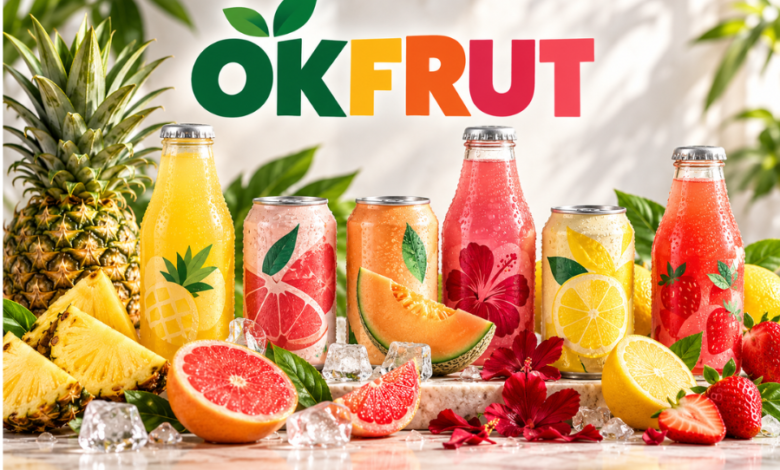
Okfrut is a fruit-flavoured beverage name with a documented US trademark, older bottled fruit drinks and more recent retail listings for zero-sugar sparkling water. The name covers drinks with markedly different ingredients and nutritional characteristics.
Records connect the trademark with Whole Fruit JPC, a Texas-based beverage business, while historical food labels identify pineapple, grapefruit, cantaloupe and hibiscus varieties. Strawberry and lemon sparkling cans have also appeared in American retail catalogues.
Yet a product being recorded does not mean it is currently stocked, and a fruit-inspired name does not guarantee pure juice. Here is what the available evidence establishes about the brand, its drinks and the details worth checking before buying.
A Beverage Brand With More Than One Identity
The most reliable answer to “what is Okfrut?” is straightforward: it is a name used for fruit-flavoured beverages. The Environmental Working Group’s Food Scores database identifies several products sold as fruit drink water, while a major US retailer has carried catalogue pages for fizzy, zero-sugar versions. These are recognisably different sorts of soft drink, despite sharing a brand name.
Some online descriptions instead treat Okfrut as a fruit-delivery business or supplement. The established trademark and packaged-product records support the beverage explanation. They do not, by themselves, substantiate an online grocery operation, a therapeutic product or a subscription platform.
Brand identity also differs from product availability. A label recorded several years ago is valuable evidence of a former formulation, not a guarantee that customers can purchase the same bottle today.
The Company Behind the Trademark
A US trademark filing dated 16 September 2014 identifies Whole Fruit JPC as the owner of the OKFRUT mark, under serial number 86981327. The goods are described as fruit-flavoured beverages. Trademark databases continue to identify the mark as registered, but the filing date should not be mistaken for a confirmed commercial launch date.
Whole Fruit JPC describes itself as an American beverage company supported by manufacturing expertise in Mexico. Its corporate website identifies San Antonio, Texas, as its US base and names SEPIM, based in Jalisco, as a sister company involved in product development and manufacturing. That connection does not prove where every Okfrut drink was made.
The company’s displayed ingredients business includes pineapple concentrate, hibiscus extract, melon pulp and limeade concentrate, alongside preparations for aguas frescas. These are traditional, usually non-alcoholic refreshments associated with Mexico and other parts of Latin America. The overlap with historically recorded Okfrut flavours is notable, although a shared flavour does not establish that any particular concentrate was used in a particular finished drink.
What the Older Bottles Reveal About the Flavour Range
The Environmental Working Group preserves five Okfrut entries based on package information captured in 2015 and 2017. They include pineapple, grapefruit labelled toronja, two cantaloupe-melon bottle sizes and hibiscus labelled jamaica. These Spanish terms are common in Mexican food culture but do not establish a sales territory.
Pineapple was documented in a 20-fluid-ounce bottle, approximately 592 millilitres. Grapefruit and one cantaloupe product appeared in 16-fluid-ounce bottles, approximately 473 millilitres. A second cantaloupe formulation and the hibiscus variety were recorded in roughly 20-fluid-ounce containers. The sizes are useful because comparing sugar figures without considering the bottle volume can create false impressions.
These records explain why fruit drink water needs care. The pineapple and grapefruit formulations included juice ingredients but were not presented as 100% juice. Cantaloupe versions included melon and apple purées. Hibiscus followed a different recipe altogether, using a hibiscus ingredient and low-calorie sweeteners.
The database marks older products distinctly. It is therefore more accurate to call these documented varieties than to present them as a complete 2026 supermarket range.
The Newer Sparkling-Water Listings
American retailer Walmart has displayed Okfrut zero-sugar sparkling water in strawberry and lemon flavours. The descriptions specify six-packs of 11.8-fluid-ounce cans, approximately 349 millilitres each, and advertise zero sugar, zero calories and zero carbohydrates. Unlike the older drinks, these are carbonated.
These listings suggest that the name has been used in more than one beverage format. They do not establish exactly when the sparkling products launched, whether they replaced older drinks or whether both lines remain in production. Nor does a retailer’s product description independently verify every ingredient in a can.
Both retailer pages showed the products as out of stock online when examined. That does not establish nationwide discontinuation. Availability can vary between delivery addresses, stores and individual sellers, and retail catalogue pages can persist when stock is unavailable.
The Sugar Difference Is Substantial
Historical labels make it impossible to describe every Okfrut beverage as sugar-free. The 2017 pineapple record reports 150 calories per 592-millilitre bottle and identifies sugar among the ingredients. The grapefruit label, captured in 2015, reports 120 calories and 26 grams of sugar in a 473-millilitre bottle.
A 2017 cantaloupe entry gives 110 calories and 25 grams of sugar per 592-millilitre bottle. The earlier, smaller cantaloupe entry reports 86 calories and 20 grams of sugar per 473 millilitres. These historical figures do not guarantee today’s formulation.
The hibiscus record is a revealing contrast. Its 591-millilitre bottle lists zero calories and no added-sugar ingredients. Instead, the archived ingredient declaration includes sucralose and acesulfame potassium. The zero-sugar description therefore needs to be understood alongside the sweetener information, rather than treated as shorthand for having no ingredients beyond water and flowers.
In Britain, the NHS advises limiting free sugars, including those in sweetened beverages. For an everyday comparison, reading total sugars per 100 millilitres can be more informative than comparing two bottles of unequal size. In the US, checking added sugars alongside total sugars offers a similar safeguard.
What Sits Behind the Fruit Flavour
The archived pineapple ingredient declaration begins with water, sugar and pineapple juice, followed by acids, preservatives, stabilisers, colourings and flavouring. This is evidence that the drink contained a real fruit ingredient, but also that its recipe extended well beyond fruit and water. The percentage of pineapple juice should not be guessed from the order of ingredients.
The historical cantaloupe labels show an equally mixed formulation: melon and apple purées alongside sugar, flavourings and, in some entries, low-calorie sweeteners. The hibiscus recipe lists colourings and preservatives as well as its floral ingredient. Individual formulations therefore differ not only in sweetness but also in their use of additives.
Food additives are regulated substances, and their presence alone does not establish that a drink is dangerous. Equally, words such as natural, fruity or refreshing are not substitutes for a full declaration. Anyone avoiding a specific colour, preservative or sweetener should consult the actual package rather than relying on old descriptions or broad assurances about the brand.
Fruit Drinks Are Not the Same as Fruit Juice
Three categories are easily confused. Pure fruit juice is obtained from fruit, sometimes reconstituted from concentrate. A fruit drink may combine juice or purée with water, sugar and additional flavourings. Sparkling flavoured water is carbonated and may contain little or no juice, depending on its recipe.
US Food and Drug Administration guidance requires drinks purporting to contain juice to declare its percentage. That is more useful evidence than fruit imagery on the front of a package. A product described as strawberry-flavoured sparkling water should not be assumed to supply the nutrients associated with eating strawberries.
The NHS also points out that even unsweetened juice contains free sugars and advises limiting juice and smoothies to a combined 150 millilitres daily. A sweetened fruit drink is not automatically an equivalent serving of fruit, however convincing its flavour may be.
Where Availability Stands for UK and US Customers
The strongest retail evidence for Okfrut is American. Walmart’s sparkling-water pages confirm that the products have been offered through a US retail catalogue, while historical label records document earlier bottled drinks. Neither source demonstrates consistent nationwide availability or confirms stock at a particular address.
Regular UK distribution has not been independently established. A British buyer encountering an import listing should verify the seller, the product’s origin, the current ingredient panel and the delivery terms. Packaging intended for one market may use different nutrition-label conventions from packaging intended for another.
A sensible purchase check goes beyond price. Confirm the exact flavour, whether the order contains one can or a multipack, its volume, best-before information and return arrangements. Product photographs can be old, so the latest package details deserve priority over an archive entry.
Why the Evidence Needs to Be Read Carefully
Okfrut has a real documentary trail, but its publicly available corporate story is less detailed than that of a major soft-drink manufacturer. The trademark establishes an association with Whole Fruit JPC; the company’s website describes its broader operations; food databases reproduce historical labels; retailers describe particular products for sale. Each record answers a different question.
None of these sources, taken alone, establishes current annual sales, the brand’s market share, a complete product catalogue or an official timeline of recipe changes. Claims about dramatic business growth, exceptional health benefits or guaranteed international delivery would require separate evidence.
For shoppers, the approach is practical. Treat the name as a starting point, identify the particular beverage and evaluate the label in front of you. That produces a more accurate answer than assuming every Okfrut drink belongs to one nutritional category.
Conclusion
Okfrut’s documented history connects a Texas-associated trademark with fruit-flavoured bottled drinks and later retail listings for zero-sugar sparkling cans. Its pineapple, grapefruit, cantaloupe and hibiscus records reveal substantial differences in sugars, sweeteners and ingredients; strawberry and lemon listings widen the picture further.
The brand is real, but its present range and distribution are not fully established in public records. The soundest way to assess Okfrut is by product, formulation and current packaging, not by the fruit imagery or the name alone.
FAQs
What Exactly Is Okfrut?
Okfrut is a beverage brand name documented in US trademark records and packaged-drink databases. Older records identify fruit-flavoured still drinks, while American retailer pages also identify zero-sugar sparkling water. Available evidence does not establish it as a fresh-fruit delivery service or medical supplement.
Which Okfrut Flavours Have Been Documented?
Historical food-label records cover pineapple, grapefruit or toronja, cantaloupe melon and hibiscus or jamaica. Walmart has also displayed strawberry and lemon sparkling varieties. These are confirmed examples of recorded products, not a verified list of every flavour currently in manufacture or in stock.
Is Okfrut Completely Sugar-Free?
No. Older pineapple, grapefruit and cantaloupe formulations contained sugar, whereas an archived hibiscus drink was labelled zero calorie and used alternative sweeteners. Strawberry and lemon sparkling products have been advertised as zero sugar. Read the current nutrition panel because recipes, formats and serving sizes differ.
Can You Buy Okfrut in the UK?
Regular distribution through UK supermarkets has not been reliably confirmed. US retail records are clearer, although even documented American listings may be out of stock. UK shoppers considering an imported product should check the seller’s credentials, delivery conditions and the label on the exact item being offered.
Does Okfrut Contain Real Fruit Juice?
Some historical formulations did. Archived pineapple information names pineapple juice, and grapefruit information names grapefruit juice concentrate. That does not make those drinks pure juice or prove the fruit content of newer sparkling products. Check the current package for any declared juice percentage and ingredient details.
