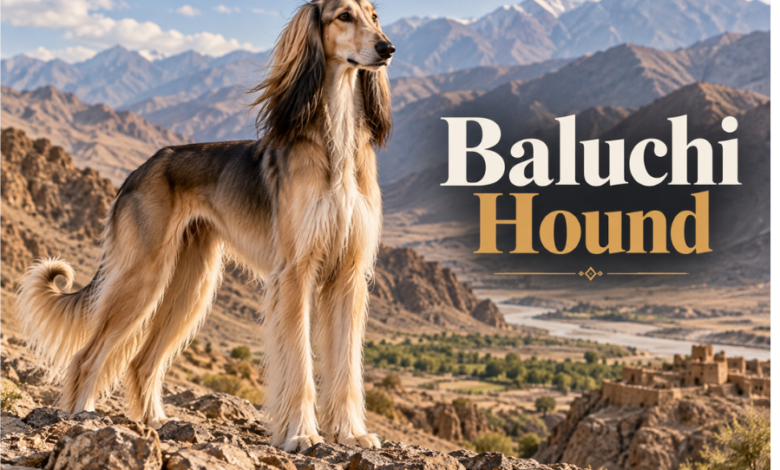
The Baluchi Hound is a historical and regional name associated with the Afghan Hound, an athletic sighthound developed for pursuing game across demanding terrain. Although the name evokes Balochistan and the wider borderlands of South and Central Asia, major international kennel organisations recognise the breed as the Afghan Hound rather than registering a separate Baluchi Hound breed.
Behind the famously flowing coat stands an independent hunting dog with remarkable speed, keen eyesight and substantial daily needs. Understanding this animal means looking beyond show-ring glamour to regional naming traditions, the development of modern pedigree lines and the practical realities of living with a determined sighthound.
Is the Baluchi Hound a Separate Dog Breed?
In most modern breed references, the answer is no. Dogs New Zealand records it among the breed’s other names, while the Library of Congress directs the subject term “Baluchi hound” to “Afghan hound”. The formal name used by the Royal Kennel Club in Britain, the American Kennel Club and the Fédération Cynologique Internationale (FCI) is Afghan Hound.
This does not mean every dog locally called a Baluchi or Tazi hound has a documented Afghan Hound pedigree. Regional terms can describe working types, local strains or related sighthounds without matching a modern breed registry’s boundaries. Photographs alone cannot establish ancestry, and similar-looking hunting dogs may belong to different breeding traditions.
A regional name alone cannot establish pedigree, health or temperament.
A Name Shaped by Geography and Hunting Culture
Balochistan stretches across parts of modern Pakistan, Iran and Afghanistan, an area historically connected by movement, trade and pastoral life. The word “Baluchi” reflects a geographic and cultural association, not proof that one precisely defined breed originated at a single location.
In working communities, hunting ability could matter more than uniform appearance; stamina, footing and adaptability were practical considerations when choosing a dog.
Names such as Tazi and Sag-e Tazi also appear in accounts of regional sighthounds. Treating those labels as exact synonyms in every setting would erase meaningful differences between local dogs.
Nineteenth-century writing about Baluchistan noted the regard in which local greyhound-type hunting dogs were held. These accounts do not prove an unbroken bloodline to today’s breed.
How the Modern Afghan Hound Took Shape
The Afghan Hound familiar in Western kennels developed through imports from Afghanistan and neighbouring areas, particularly in the early twentieth century. The FCI accordingly identifies Afghanistan as the country of origin and Great Britain as the country of patronage.
Show standards eventually established a recognisable pedigree ideal, but they do not capture the full variety of dogs historically bred for hunting throughout the region.
Afghan hunting dogs varied according to local terrain and breeding priorities, and the precise relationship between historical regional types cannot be reconstructed from anecdotes alone. Claims that an unchanged modern breed existed for thousands of years should therefore be treated cautiously.
The American Kennel Club recognised the Afghan Hound in 1926, marking an important step in its international show and breeding history. The FCI granted definitive recognition in 1961. These dates mark kennel recognition, not the beginning of sighthound hunting.
Built for Speed, Sight and Uneven Ground
An adult Afghan Hound is tall, narrow-waisted and deep-chested, with long legs, powerful hindquarters and an unmistakably elevated way of moving. Its head is long and refined, while the tail typically ends in a distinctive ring or curve.
The American Kennel Club gives a typical height of approximately 25–27 inches and a weight of 50–60 pounds. Prominent hipbones can be normal in this lean breed, although a veterinarian should assess any suspected weight problem.
Sighthounds rely heavily on vision to identify moving targets. Their long stride helps cover ground efficiently, while agility matters on difficult surfaces. This helps explain their enduring instinct to chase wildlife or other moving animals.
The Silky Coat Has a Serious Maintenance Cost
The Afghan Hound’s coat is among its most recognisable features. Long, fine hair covers much of the body, with feathering on the ears and legs and a topknot on the head. Mature dogs commonly retain a shorter-haired area along the back, known as the saddle. Many coat colours are recognised.
The coat is traditionally associated with protection in colder mountain conditions, but maintaining it in a household is demanding. Fine hair tangles easily, particularly behind the ears, under the legs and anywhere harnesses create friction.
Paws and ears also deserve inspection after outdoor exercise, since grass seeds and debris can hide beneath feathering.
The Royal Kennel Club describes grooming as a daily requirement, while the American Kennel Club advises several hours of brushing each week alongside regular bathing. Owners should learn proper detangling techniques, use suitable grooming products and check the skin as they work.
Anyone drawn primarily to the breed’s luxurious appearance should first consider whether that upkeep is realistic.
Temperament: Independent, Affectionate and Sometimes Comical
The breed is often described as dignified or reserved with strangers, yet owners also encounter playful, mischievous behaviour at home. An Afghan Hound can form strong bonds with familiar people without demanding constant attention.
Independence is central to the experience of living with one. A dog developed to make quick decisions while pursuing prey may not respond like a breed selected for close, continuous direction from a handler.
Early positive experiences with visitors, traffic, handling and other dogs help puppies become adaptable adults. Owners also need to respect resting space and body language, especially in busy family homes.
Exercise Requires More Than a Brief Walk
The Royal Kennel Club places the Afghan Hound in its highest everyday exercise category, indicating more than two hours a day. Short outings alone are inadequate.
Safe running opportunities add an essential outlet for speed. Because a sighthound may pursue something before an owner can react, vigorous off-lead exercise belongs in a genuinely secure enclosed area. Secure fencing must also prevent jumping and escape.
An enclosed running field is often safer than a public park, especially where wildlife might trigger an unexpected pursuit.
Puppies should not be pushed into sustained running or repetitive high-impact activity before they mature. Older dogs may need shorter sessions and veterinary-guided adjustments. Food puzzles and calm training provide valuable mental stimulation.
Training Around a Powerful Chase Instinct
Training succeeds best with patience, clear routines and rewards the dog genuinely values. Reliable household skills include settling, comfortable grooming, loose-lead walking and responding to a name despite distractions.
Recall deserves special attention, but even a well-trained Afghan Hound can ignore a cue when prey is moving. The American Kennel Club specifically warns against relying on off-lead control in unsecured places.
A long line used with an appropriate harness can provide managed freedom where conditions permit, without gambling on instinct disappearing.
Structured, reward-based work and careful environmental management offer a more sensible long-term approach.
Family Homes, Children and Other Animals
An Afghan Hound can live comfortably with considerate children, provided adults supervise interactions and teach children not to pull hair, corner the dog or interrupt sleep. Its size and speed make supervision particularly important with toddlers.
Relationships with other dogs depend on experience, temperament and introductions. Cats and smaller pets require more caution because the breed’s prey drive may be strong even when the dog is calm indoors.
Some individuals live successfully with animals they know; others may never be safe unsupervised around them. New introductions should allow both animals to retreat, with barriers and separate rooms available when necessary.
A garden cannot substitute for proper training and daily activity.
Health, Lifespan and Responsible Breeding
The American Kennel Club gives an expected lifespan of 12–18 years, whereas the Royal Kennel Club describes the breed more broadly as living beyond ten years. Neither figure predicts an individual dog’s longevity.
Prospective owners should discuss hip health, eye disease and thyroid function with breeders and veterinarians. The American Kennel Club’s national breed-club recommendations include hip, ophthalmological and thyroid evaluations.
In Britain, the Royal Kennel Club identifies hip screening among its best-practice breeding tests. Request actual test results, not verbal assurances, and discuss any relevant family health history with a veterinarian.
The UK veterinary charity PDSA also notes hypothyroidism and a rare neurological condition, necrotic myelopathy, among breed-related concerns. The Afghan Hound Club of America has highlighted chylothorax, an accumulation of lymphatic fluid in the chest, as an area of specialist research.
Owners should additionally know the warning signs of gastric dilatation-volvulus, or GDV, a life-threatening emergency associated with deep-chested dogs. Unproductive retching, a swollen abdomen, severe restlessness or collapse demand immediate veterinary attention.
Choosing a Puppy or Considering Rescue
Finding a healthy companion starts with the breeder’s practices, not the rarity of a name or an unusually coloured coat. Ask to meet the mother where possible, see the rearing environment and review documented parental health testing.
In the UK, buyers can consult Royal Kennel Club guidance and recognised breed clubs; American buyers can approach established Afghan Hound organisations. Avoid sellers who promise a supposedly separate rare Baluchi pedigree without credible evidence.
Rescue and rehoming are also worth considering, particularly for experienced sighthound households. Their individual histories and needs deserve careful assessment.
Why the Older Name Still Matters
The Baluchi Hound name preserves a connection to the regional hunting cultures behind a globally recognised dog. It also reminds us that formal pedigrees are only one chapter in the history of working animals.
Recognising that heritage does not require inventing a separate breed standard. Instead, it encourages a more accurate distinction between historical sighthounds, dogs currently working in their home regions and the modern registered Afghan Hound.
Conclusion
The Baluchi Hound is best understood as a name linked to the Afghan Hound and the wider sighthound traditions of Balochistan and neighbouring regions. Its appeal reaches beyond an extraordinary coat: this is a fast, perceptive hunting dog whose independence, exercise needs and grooming demands shape everyday ownership.
Clear terminology protects the breed’s history while helping prospective owners make responsible decisions about the dog in front of them.
FAQs
Is a Baluchi Hound the same as an Afghan Hound?
Major kennel and reference organisations treat Baluchi Hound as an alternative name for the Afghan Hound, not a separately registered breed. However, a locally named hunting dog does not automatically have a traceable Afghan Hound pedigree. Registration documents and individual assessment matter when establishing a particular dog’s background.
Where did the Baluchi Hound originate?
The name is associated with Balochistan and surrounding hunting traditions, while formal breed authorities designate Afghanistan as the Afghan Hound’s country of origin. The precise ancestry of older regional hounds is not completely documented. It is more accurate to acknowledge a shared historical landscape than claim one proven birthplace for every type.
How much exercise does this dog need?
The Royal Kennel Club recommends more than two hours of daily exercise for Afghan Hounds. This can include walks, appropriate enrichment and opportunities to run inside secure fencing. Age, fitness and veterinary advice should determine intensity, particularly for puppies, injured dogs and older animals.
Is the Baluchi Hound suitable for first-time owners?
It is generally better suited to someone prepared for independent behaviour, substantial grooming and careful management of prey drive. A committed first-time owner can succeed with professional training support and realistic expectations, but its demands make it a less straightforward choice than many conventional companion breeds.
Do Baluchi Hounds get along with cats?
Some Afghan Hounds coexist peacefully with familiar cats, especially after carefully managed introductions. Others retain a strong instinct to chase smaller animals. There is no universal guarantee of compatibility; separation, supervision and secure household arrangements may be necessary throughout the dog’s life.