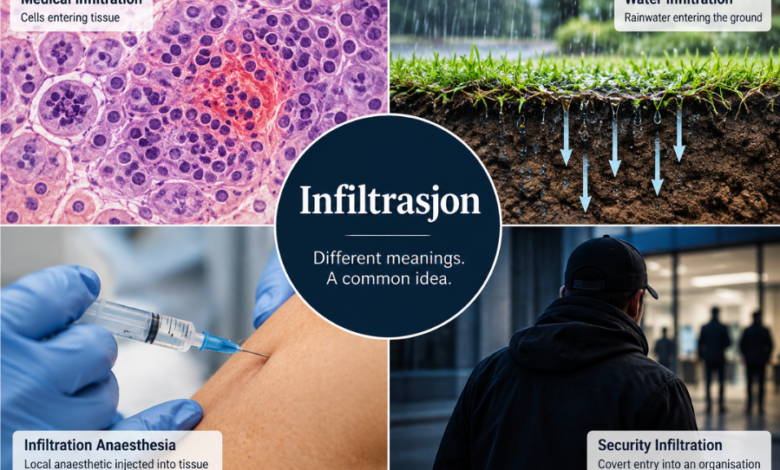
“Infiltrasjon” is a Norwegian word whose direct English equivalent is “infiltration”. The complication is that it does not describe one single process. In Norwegian, it can refer to cells or fluid entering tissue, water soaking into the ground, local anaesthetic being delivered into tissue, or covert entry into an organisation or territory. Norway’s official dictionaries recognise several of these meanings.
Context is therefore essential. Someone who sees infiltrasjon in a pathology report is dealing with a very different concept from an engineer discussing rainfall or a historian describing intelligence activity. This guide explains the main meanings, how the term is used professionally, and what readers should look for when they encounter it.
The Core Meaning Behind Infiltrasjon
At its simplest, infiltrasjon describes something entering, penetrating or spreading into another material, space or structure. That idea connects otherwise very different uses of the word.
Bokmålsordboka gives three broad senses: covert placement of people within a state, organisation or company; physical penetration or permeation; and, in medicine, the entry of fluid, cells or other material between tissue cells. “Infiltration” is therefore a sound general translation, but the subject determines what the term actually means.
In a hospital note, infiltrasjon may concern inflammation, tumour growth or an injection technique. In construction or environmental planning, it may describe rainwater entering soil. In security, it can mean covert entry into a group or territory.
Infiltrasjon in Medicine and Pathology
Medical use is one of the most important meanings. Store medisinske leksikon defines infiltrasjon as the entry of fluid or cells into a tissue or organ. It notes that inflammation can involve fluid and inflammatory cells entering tissue, while cancer cells can extend beyond their usual boundaries into surrounding tissue or organs.
Here, infiltrasjon is usually a descriptive process rather than a diagnosis by itself. A report may use the term to explain how inflammation is distributed or whether abnormal cells have entered nearby structures.
Inflammation and Cellular Infiltration
When tissue becomes inflamed, immune cells and fluid can accumulate within it. Pathologists may describe an inflammatory infiltrate according to its location, density and cell type. The word does not by itself show how serious the underlying condition is; interpretation depends on the organ involved, the cells present and the wider clinical findings.
For patients reading translated records, this distinction matters. Inflammatory infiltration and malignant infiltration are not interchangeable, even though both may contain the same root term.
Infiltrating or Invasive Tumour Growth
In cancer pathology, infiltration can describe tumour cells growing into neighbouring tissue. The Norwegian medical encyclopaedia refers to this as infiltrating growth. In English-language oncology, related terms such as “invasive”, “infiltrative” or “infiltrating” may appear depending on the cancer type and reporting convention.
A pathology report must therefore be read as a whole. Terms concerning margins, depth of invasion, grade and stage may carry more clinical meaning than the word infiltrasjon alone. Personal reports should be interpreted by the treating clinician rather than through translation alone.
When Infiltrasjon Means a Medical Injection Technique
There is another medical use that can be confused with pathology. Infiltrasjon can describe medication being injected directly into tissue or around a painful area. Norwegian reimbursement terminology uses “infiltrasjon (injeksjon)” for local anaesthetic delivered to areas including skin, mucosa, tendon attachments, bursae and tendon sheaths.
This is distinct from naturally occurring cellular infiltration.
Infiltration Anaesthesia
“Infiltrasjonsanestesi” means infiltration anaesthesia. A local anaesthetic is injected into tissue so nerve endings in that area are temporarily blocked. The Norwegian Pharmaceutical Handbook describes local anaesthetic infiltration into underlying tissue and notes that commonly used agents have a rapid onset.
Dentistry is a familiar example. Local anaesthetic may be deposited into oral tissue before treatment. Norwegian guidance distinguishes local infiltration from nerve-block techniques, with the method depending on the area that needs to be anaesthetised.
In English-language healthcare, related phrases include “local infiltration”, “local anaesthetic infiltration” and “wound infiltration”.
Steroid and Pain-Relief Injections
Some local injections combine a corticosteroid with local anaesthetic to reduce inflammation and pain around joints or soft tissues. NHS guidance explains that corticosteroid injections may be used for inflammatory joint and tendon problems, with local anaesthetic sometimes added for temporary pain relief.
Responses vary, and repeated steroid injections can carry risks including tendon or cartilage damage, infection, temporary blood-sugar elevation and short-term pain flares. The word infiltrasjon in a treatment plan therefore does not reveal which drug is being used; the medication, site and purpose need to be checked.
Infiltrasjon in Hydrology and Stormwater Management
Outside medicine, a major technical meaning concerns water entering the ground. Store norske leksikon defines hydrological infiltrasjon as water moving from the surface down into soil or ground.
This process is central to drainage and flood prevention. Rainfall that soaks into permeable soil creates less immediate surface runoff than rainfall landing on sealed surfaces such as roofs, asphalt and concrete.
Norway’s Water Resources and Energy Directorate explains that runoff increases when soil is saturated or frozen, surfaces are impermeable, or rainfall intensity exceeds the ground’s infiltration capacity. In urban areas, reduced infiltration can contribute to faster runoff, larger flood peaks, erosion and drainage pressure.
Why Cities Use Infiltration Systems
Modern stormwater planning tries to manage rainfall close to where it lands. Norwegian environmental guidance describes a three-stage approach based on infiltration, detention and safe conveyance: smaller volumes are allowed to infiltrate, larger volumes may be stored temporarily, and excess water must be routed safely away.
Practical solutions include rain gardens, permeable surfaces, infiltration trenches, pipes and chambers. Suitability depends on soil, groundwater, terrain, contamination risk and available space.
The principle has direct equivalents in the UK and United States, where sustainable drainage and green infrastructure also aim to restore or mimic natural infiltration.
Infiltrasjon in Security, Politics and Organisations
Another established meaning concerns covert entry. Bokmålsordboka includes the deliberate placement of soldiers, spies or advocates inside another state, organisation or company for sabotage, subversion or influence.
English uses “infiltration” similarly in military, intelligence, criminal and organisational contexts. The term implies concealed or gradual entry, not ordinary participation.
Because it carries strong implications about hidden intent, it should be used carefully in journalism, legal reporting and political discussion. Claims of infiltration are best tied to documented conduct or clearly attributed sources rather than treated as a neutral description of membership.
How to Work Out Which Meaning Is Intended
The surrounding vocabulary usually reveals the meaning of infiltrasjon.
Mentions of biopsy, inflammation, tumour cells or pathology usually point to tissue infiltration. Lidocaine, anaesthesia, joints or pain treatment suggest an injection technique. Rainwater, soil, drainage, runoff or groundwater indicate hydrology. Intelligence, espionage or covert activity point to the security meaning.
Translation software may return only “infiltration”, which is technically correct but sometimes too vague. Professional documents may require a more specific phrase such as “local anaesthetic infiltration”, “tumour invasion”, “cellular infiltration”, “stormwater infiltration” or “covert infiltration”.
That precision matters especially in medical, engineering and legal material, where an overly broad translation can alter how a reader understands the document.
Conclusion
Infiltrasjon is one Norwegian term with several specialised meanings linked by a basic idea: something entering or spreading into something else. In medicine, it can describe cells or fluid moving into tissue or a deliberate injection technique. In hydrology, it describes water moving into the ground. In security, it can mean covert entry into an organisation or territory.
For readers in the UK or United States, “infiltration” is usually the correct first translation, but not always the most precise final wording. The subject area, neighbouring terms and professional context determine what infiltrasjon actually means and how it should be translated.
FAQs.
What does infiltrasjon mean in English?
The closest general English translation is “infiltration”. Depending on context, it may refer to cells or fluid entering tissue, medication being injected locally, water soaking into the ground, or covert entry into an organisation or territory.
What does infiltrasjon mean in a medical report?
In medicine, it commonly refers to fluid, inflammatory cells or abnormal cells entering tissue or an organ. It can occur in inflammation and can also describe infiltrative tumour growth. The surrounding wording determines which meaning applies.
Is infiltrasjon the same as an injection?
Not always. Infiltrasjon can describe a natural or disease-related process inside tissue, but it can also refer to a local injection technique. “Infiltrasjonsanestesi”, for example, is local anaesthetic infiltration used to numb tissue for a procedure.
What is stormwater infiltrasjon?
Stormwater infiltration is rain or meltwater moving from the ground surface into soil. It can reduce immediate surface runoff and is an important part of drainage and flood-management strategies where local ground conditions are suitable.
Can infiltrasjon have a security meaning?
Yes. Norwegian dictionaries also use the word for covert entry into a state, organisation or company, particularly when the purpose is sabotage, subversion or influence. English “infiltration” has a similar security meaning.