
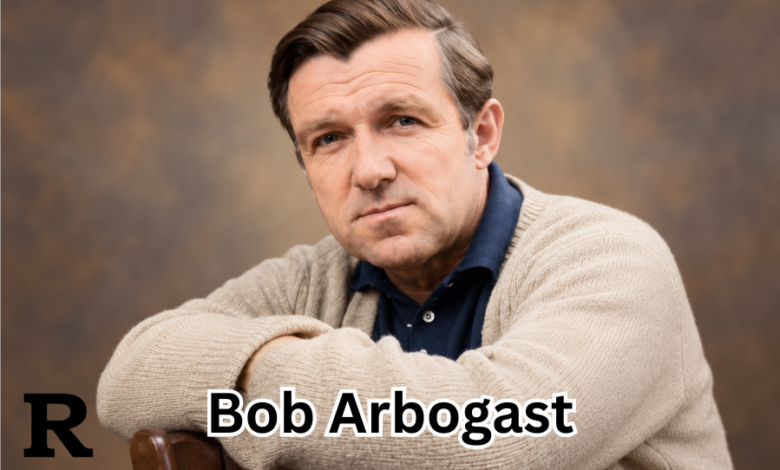
Bob Arbogast belonged to a generation of entertainers whose work was often more familiar than their faces. A radio personality, comedy writer and voice actor, he moved between broadcasting, animation, advertising and television as American media changed from the 1950s through the 1980s. He became especially associated with Los Angeles radio and the animated series Roger Ramjet, while also contributing to Sesame Street, Square One Television and Pat Paulsen’s Half a Comedy Hour.
His career is interesting because it sits at the meeting point of several forms of entertainment: radio, advertising, animation, educational television and network comedy.
Quick Bio
| Detail | Information |
|---|---|
| Full Name | Bob Arbogast |
| Date of Birth | 1 April 1927 |
| Place of Birth | Bellingham, Washington, United States |
| Date of Death | 21 March 2009 |
| Age at Death | 81 years |
| Nationality | American |
| Profession | Radio broadcaster, voice actor, comedy writer and television performer |
| Known For | Roger Ramjet, radio comedy, commercial voiceovers and children’s television |
| Notable Voice Roles | General G.I. Brassbottom and Ma Ramjet in Roger Ramjet |
| Television Work | Sesame Street, Square One Television, Mork & Mindy |
| Radio Career | Worked at stations including KMPC, KLAC, KFI and KGBS |
| Writing Credits | Pat Paulsen’s Half a Comedy Hour and other comedy programmes |
| Famous Advertising Association | Widely credited with the original “What would you do for a Klondike Bar?” campaign |
| Death Place | Fresno, California, United States |
A Career Built Around Voice, Timing and Radio
Arbogast was born on 1 April 1927 in Bellingham, Washington. The Los Angeles Times reported that he later attended Marshall High School in Los Angeles, served in the US Navy near the end of the Second World War, and studied at Los Angeles City College and the University of Arizona after leaving the service. His early radio experience included work in Tucson before he moved into larger broadcasting markets.
Radio became the foundation of his professional identity. He worked in Kansas City and then at WMAQ in Chicago during the early 1950s, when personality-driven radio depended heavily on quick writing, comic timing and distinctive voices. Later, he worked in San Francisco at KSFO and KFRC before establishing himself more prominently in Los Angeles.
His career developed around comedy, character work and writing, skills that later transferred naturally into cartoons and commercials.
Los Angeles Radio Put Bob Arbogast in a Bigger Spotlight
By the early 1960s, Arbogast was working in the competitive Los Angeles radio market. From 1962 to 1967 he was at KMPC, where the Los Angeles Times notes that he wrote for broadcasters Dick Whittinghill and Gary Owens. Owens would later become closely associated with Roger Ramjet, creating another link between Arbogast’s radio and animation careers.
In 1967, Arbogast moved to KLAC and formed an on-air partnership with Jack Margolis. Contemporary recollections and later profiles describe their programme as a popular comedy-driven show built around sketches, topical humour and the chemistry between the two performers.
The partnership also briefly moved to television on KTTV. Arbogast later worked at Los Angeles stations including KFI and KGBS.
His work in the city placed him firmly within a broadcasting culture where radio personalities were expected to do far more than introduce records. Writing, improvisation, comic voices and topical material were central to the job.
Roger Ramjet Became His Most Recognisable Cartoon Credit
For animation fans, Bob Arbogast is closely tied to Roger Ramjet, the short-form superhero cartoon that ran in the 1960s. Gary Owens voiced the title character, while Arbogast performed supporting parts including General G.I. Brassbottom and Ma Ramjet.
The programme’s rapid-fire jokes and exaggerated characters suited a performer trained in radio. Voice actors had to establish personalities quickly, often within brief episodes that moved from set-up to punchline at speed.
Arbogast’s work on the series showed his range. Instead of being identified with one signature character, he could move between contrasting voices and comic types. Specialist credits also connect him with animation including The Jetsons, Hot Wheels, Monchhichis and Galtar and the Golden Lance.
These credits help explain his lasting interest to animation historians.
The Commercial Voice Many Listeners Heard Without Knowing His Name
Advertising was another important part of Arbogast’s working life. Biographical sources widely credit him as the voice associated with the original “What would you do for a Klondike Bar?” campaign, one of the best-known American advertising slogans of its era. He is also associated with the animated Granny Goose character used to promote Granny Goose potato chips.
Voiceover work rarely made performers famous; the product or character was meant to be remembered instead.
That anonymity makes Arbogast’s career particularly interesting. A listener might have encountered him on radio, in a cartoon or in a commercial without realising the same performer was behind all three. His professional value came from adaptability rather than from building a single public persona.
It also reflects an important feature of twentieth-century American voice work. Performers could become highly familiar to audiences without receiving the name recognition enjoyed by actors whose faces appeared regularly on screen.
Writing Was as Important as Performing
Arbogast also worked as a television comedy writer, including on Pat Paulsen’s Half a Comedy Hour in 1970. Production credits list him among the writers across the series, alongside a comedy team that included Bob Einstein and Steve Martin.
He also received writing credits connected with Turn-On, the short-lived 1969 television comedy experiment, and other projects.
This side of his career helps explain why his voice performances had such precise comic rhythm. Arbogast understood jokes structurally as well as vocally: how a line should be shaped, where a pause belonged and how a character could make an ordinary sentence funny.
His work therefore fits more accurately within the wider tradition of American broadcast comedy than within voice acting alone. The microphone was central to his career, but writing was part of the same skill set.
Sesame Street and Educational Television Added Another Dimension
Arbogast contributed voice work to animated inserts for Sesame Street. Specialist programme archives identify him as a performer in several animated segments, sometimes as a narrator and sometimes as a character voice.
Years later, he worked on Square One Television, the mathematics-focused children’s programme produced by the Children’s Television Workshop. He voiced Mr. Beasley in the animated “Dirk Niblick of the Math Brigade” segments and also appeared on camera in a Mathnet episode as Byle Dupe.
The connection is notable because educational television benefited from exactly the skills Arbogast had spent decades developing: clear delivery, comic characterisation and the ability to make short pieces of information entertaining.
His work also demonstrates how the boundaries between commercial entertainment and educational broadcasting were more fluid for voice performers than audiences might assume.
Screen Appearances Were Small but Memorable
Although most of his career happened behind a microphone or behind the scenes, Arbogast occasionally appeared on camera. His television credits include a policeman in the 1979 Mork & Mindy episode “In Mork We Trust.”
He also appeared in the 1985 film The Falcon and the Snowman and had other smaller screen credits. These appearances were never the main basis of his career, but they show his ability to move between performance formats.
That versatility is one reason his résumé looks unusually broad. Radio, television writing, animation, commercials, educational programming and occasional acting were different uses of the same comic and vocal skill set.
His Place in American Broadcasting History
Arbogast died of cancer on 21 March 2009 in Fresno, California, aged 81. At the time, he was living in Mariposa, California. The Los Angeles Times remembered him principally as a comedy writer and radio personality, while also noting that Roger Ramjet was among his best-known voice contributions.
His legacy is easiest to understand through the variety of places his work appeared. He belonged to an era when talented radio performers could move into television, advertising and cartoons without needing to become household names.
Colleagues such as Gary Owens, Jack Margolis and Pat Paulsen also connect his career to several strands of post-war broadcasting.
For audiences discovering him decades later, the appeal lies less in one defining performance than in seeing how widely his skills travelled. His career offers a useful snapshot of an entertainment industry in which radio-trained performers supplied voices, jokes and characters across multiple media.
Conclusion
Bob Arbogast’s career is a reminder that some of the most versatile people in entertainment are heard far more often than they are seen. From Los Angeles radio and comedy writing to Roger Ramjet, Sesame Street, Square One Television and commercial voiceovers, he built a body of work across several corners of American broadcasting.
Rather than being defined by a single role, Arbogast’s significance comes from his adaptability. He could write a joke, perform it, turn it into a character and carry the same instincts into radio, animation or advertising. That range is what makes Bob Arbogast worth rediscovering today.
FAQs.
What was Bob Arbogast best known for?
Bob Arbogast was best known as an American radio personality, comedy writer and voice actor. His most recognised animation work came from Roger Ramjet, where he voiced General G.I. Brassbottom, Ma Ramjet and other characters. He was also active in Los Angeles radio and television comedy writing.
Was Bob Arbogast the voice of the Klondike Bar commercials?
Biographical sources widely credit Arbogast with the original “What would you do for a Klondike Bar?” advertising campaign. Historical commercial voice credits are not always documented as thoroughly as film or television credits, so the attribution is best presented with that qualification.
Did Bob Arbogast work on Sesame Street?
Yes. Programme archives credit him with voice work in animated Sesame Street inserts. He later contributed to another Children’s Television Workshop production, Square One Television, where he voiced Mr. Beasley and appeared in a Mathnet episode.
Did Bob Arbogast appear in Mork & Mindy?
Yes. He appeared as a policeman in “In Mork We Trust,” an episode from the first season of Mork & Mindy that aired in 1979. It was one of his relatively limited on-camera roles compared with his radio, writing and voiceover work.
What was Bob Arbogast’s net worth?
There is no reliable public record establishing Bob Arbogast’s net worth. Although he worked for decades in broadcasting, commercials, television and animation, credible financial disclosures or authoritative wealth estimates are not publicly available.
When did Bob Arbogast die?
Bob Arbogast died on 21 March 2009 in Fresno, California, after cancer. He was 81. His career stretched across several decades of American radio and television, beginning in the post-war broadcasting era and extending into later voice and children’s television work.
READ THIS TOO: Shane Fury: The Quiet Fury Brother Still Close to Boxing



One Comment