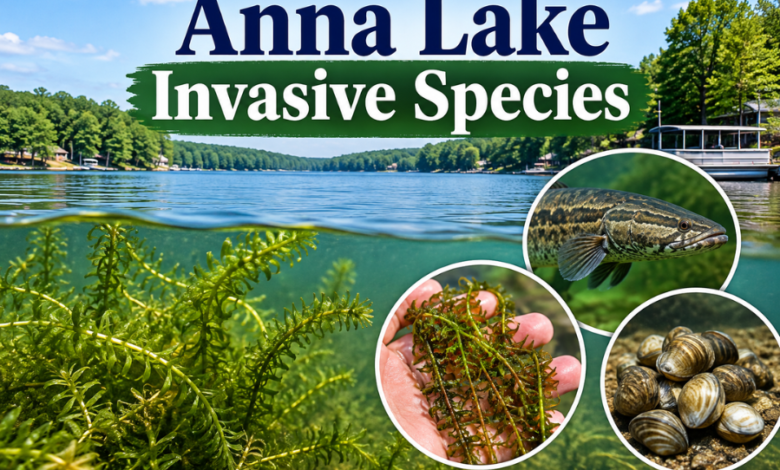
Hydrilla has been a recognised problem at Virginia’s Lake Anna since the late 1980s, and the fight to contain it remains active in 2026. The fast-growing underwater plant can obstruct boats, overwhelm coves and alter the balance of a reservoir prized for fishing, swimming and lakeside recreation.
Other introduced organisms, including northern snakeheads and Asian clams, have also reached the lake, while additional invaders threaten surrounding habitats. Understanding Anna Lake invasive species means separating established populations from potential arrivals and distinguishing ecological damage from other water-quality concerns. Here is what has actually been documented, why it matters and how local authorities are responding.
Why Lake Anna Is Vulnerable
Lake Anna covers roughly 9,600 acres across Louisa, Orange and Spotsylvania counties in central Virginia. Created for power-station cooling, the reservoir is now a popular recreational destination.
Aquatic vegetation can cling to boat trailers, fishing equipment or propellers, allowing unwanted plants to spread between waterways.
Lake Anna has a public reservoir and a separate Waste Heat Treatment Facility, commonly called the private side.
Hydrilla: The Main Anna Lake Invasive Species Concern
Why One Underwater Plant Creates Such Large Problems
Hydrilla, scientifically known as Hydrilla verticillata, is a submerged perennial that grows from the lakebed towards the surface. Its thin, branching stems carry narrow leaves, usually grouped in whorls of four or more, with small teeth along their edges.
It spreads through plant fragments as well as underground structures and small reproductive buds called turions. A broken piece moved to another cove can establish new growth.
Dense hydrilla can entangle propellers, limit access to docks and crowd other aquatic plants. Thick surface growth may also change light conditions and habitat.
Decades of Management, Not a Sudden Outbreak
Hydrilla was documented at Lake Anna in the late 1980s and became a serious navigation concern during the early 1990s. Anglers valued the cover it offered fish, while boaters and homeowners struggled with obstructed channels and waterfront access.
The Lake Anna Advisory Committee has carried out annual hydrilla management since 2015. Its strategy combines mapped surveys, selective herbicide applications and carefully controlled stocking of sterile grass carp that consume aquatic vegetation.
A lake without submerged plants would lose important shelter for juvenile fish, sediment stability and some natural nutrient uptake.
What Changed in the 2026 Hydrilla Plan?
In January 2026, the Lake Anna Advisory Committee adopted an updated management protocol and treatment plan. Its approved annual hydrilla budget was $30,000, making prioritisation essential rather than optional.
The plan identified three public-reservoir areas for targeted chemical treatment and proposed replenishing sterile carp in Mitchell Creek, Freshwater Creek and the upper North Anna area. It also authorised 13 separately funded treatment requests from homeowners or property associations, subject to the same coordination and permitting requirements.
Affected locations included communities near Duke’s Plantation, Rockland Creek Estates, Johnson’s Point and Duke’s Creek.
Local coverage later described spring carp stocking, summer treatment activity and a completed main-lake management programme. The county’s published plan also records separate watch lists for the upper reservoir, lower reservoir and private-side facility.
Those records help compare changing plant coverage across seasons instead of treating every sighting as an emergency. Dominion Energy separately placed 250 sterile grass carp in five areas of the private-side facility in May, according to that coverage.
Why Both Carp and Herbicides Are Used
Triploid grass carp are bred to be sterile. They offer longer-term grazing pressure without establishing a reproducing population, but they are still non-native fish and must be stocked under official authorisation. Too many can remove desirable vegetation along with hydrilla.
Approved aquatic herbicides can focus intervention where excessive growth threatens navigation. Mechanical cutting or raking is not recommended at Lake Anna because it can scatter viable fragments and spread the infestation.
For private-side homeowners, Dominion Energy manages and funds its own hydrilla mitigation. Public-side requests go through the advisory committee’s established process; residents should not independently introduce carp or apply chemicals.
Northern Snakeheads and Other Introduced Fish
Northern snakeheads are another established concern. The first widely verified angler catch from Lake Anna occurred in 2017, and subsequent fisheries surveys confirmed that these predatory fish were present.
Native to parts of Asia, snakeheads can inhabit weedy, shallow freshwater and feed on fish and other aquatic animals. Their arrival raised questions about competition with largemouth bass and effects on the wider food web, although presence alone does not prove they have caused a measurable collapse in native sport fisheries.
For context, fisheries material presented to a regional professional committee recorded an electrofishing catch rate of 6.4 snakeheads per hour at Lake Anna in 2023, compared with 115.2 largemouth bass per hour. These figures describe those particular surveys, not the total number of fish living in the reservoir.
Blue catfish have also been documented at Lake Anna. Virginia’s Department of Wildlife Resources describes their abundance there as low and their source as unknown.
Moving live fish between waters can introduce competitors, predators or diseases into a fish community whose balance took decades to develop. Virginia has specific handling rules for snakeheads, so anglers should consult the latest state guidance rather than assuming the rules for ordinary game fish apply.
Asian Clams: An Older, Less Visible Introduction
Unlike hydrilla, Asian clams live mostly out of sight on the bottom. Often called Asiatic clams and associated with the genus Corbicula, these small filter-feeding molluscs reproduce quickly and can compete with native freshwater mussels.
Historical environmental documentation for the North Anna Power Station records Asian clams in Lake Anna samples from 1979. Their densities subsequently fluctuated, with monitoring indicating that population levels were not consistently increasing.
Large colonies of Asian clams can interfere with water infrastructure by accumulating in pipes, although this does not establish that Lake Anna currently faces such a blockage problem. Their less obvious impact is ecological: changes to bottom habitats, nutrient cycling and competition for food.
Once an introduced freshwater mollusc becomes widespread, eliminating it from a reservoir is generally impractical.
Potential Arrivals: Water Chestnuts and Zebra Mussels
Not every species mentioned in local invasive-species warnings has been confirmed in Lake Anna.
In April 2024, the Lake Anna Civic Association warned residents to watch for two-horned water chestnut, an invasive floating plant found elsewhere in Virginia. Crucially, the association said its surveys had not identified the plant in Lake Anna at that time.
The warning was preventive, not evidence that an established infestation was already affecting the reservoir.
Zebra mussels pose another potential introduction threat because they attach to hard surfaces, compete with native mussels and can foul water equipment. Virginia’s Department of Wildlife Resources states that the state has no known established zebra mussel population. Lake Anna should therefore not be described as infested without new verified evidence.
Invasive Plants Beyond the Waterline
The shoreline and surrounding woodlands face a different set of biological pressures. Japanese honeysuckle and Chinese bush clover are among the invasive plants highlighted in the Lake Anna Civic Association’s local vegetation guidance.
The 2025 update to Lake Anna State Park’s master plan also identified wavyleaf basketgrass along recreational trails and tree-of-heaven near former structures.
Wavyleaf basketgrass is particularly relevant to visitors. Foot traffic off designated trails may move seeds into previously unaffected areas. Keeping to marked routes and cleaning footwear after visiting infested sites can reduce accidental transport.
Native shoreline plants’ roots help hold soil, their stems provide shelter and their flowers support wildlife. Removing invasive growth without restoring suitable native species can leave an opening for another invasion.
Are Harmful Algal Blooms an Invasive-Species Problem?
Lake Anna’s harmful algal blooms are a serious public-health and water-quality concern, but they should not automatically be labelled an invasive-species outbreak. Cyanobacteria occur naturally in freshwater; under favourable conditions, some can multiply rapidly and produce toxins.
A United States Geological Survey study published in September 2026 examined 19 months of lake and tributary data. It identified a complex combination of nutrients, temperature, suspended sediments, weather and boating-related sediment disturbance behind bloom patterns, especially in the western river-fed sections.
Aquatic plants take up nutrients and stabilise sediments, potentially helping water quality, while excessive weed growth creates separate ecological and access problems. Cutting every plant is therefore not a credible solution to algal blooms.
The study also recorded low concentrations of certain cyanobacterial toxins, demonstrating why monitoring is more informative than assumptions based on water colour. For swimming decisions, official Virginia Department of Health advisories and current sampling results matter more than how clear a section of water looks.
How Residents and Visitors Can Prevent Further Spread
Virginia wildlife officials emphasise a simple principle: clean, drain and dry boats and recreational equipment between water bodies.
Inspect trailers, propellers, anchors, ropes and fishing gear for plant material. Remove all aquatic vegetation when leaving the water, drain bilges and livewells, and allow equipment to dry thoroughly before using it elsewhere.
Never empty unwanted aquarium plants or animals into a lake, and do not release leftover bait.
If an unfamiliar plant appears, photograph it, record its location and report it through the Lake Anna Advisory Committee or relevant state wildlife channels. Avoid breaking it into fragments or treating it with chemicals yourself.
Funding and the Long-Term Outlook
Lake Anna’s response is increasingly collaborative. The advisory committee coordinates public-reservoir hydrilla work with the Virginia Department of Wildlife Resources and Dominion Energy, while the Lake Anna Civic Association contributes monitoring and education.
In June 2026, Louisa County announced state support for invasive hydrilla control, navigation buoys and harmful-algae mitigation. The subsequent two-year funding arrangements included $30,000 in each of fiscal years 2027 and 2028 for hydrilla management and buoy work.
Progress depends on whether managers can preserve navigation, monitor emerging threats and sustain a functioning aquatic ecosystem without causing new problems through excessive intervention.
Conclusion
The most consequential Anna Lake invasive species challenge remains hydrilla, but confirmed snakeheads and Asian clams show that the issue extends beyond underwater weeds. Virginia’s evolving response combines careful surveys, controlled treatments, preventative measures and public participation. Keeping Lake Anna healthy depends as much on stopping future introductions as on managing species already established.
FAQs
What Is the Biggest Invasive Species Problem at Lake Anna?
Hydrilla is the clearest active management priority. It can rapidly form dense submerged growth that blocks docks, interferes with boating and displaces other vegetation. The Lake Anna Advisory Committee has coordinated annual management since 2015, including sterile grass carp, authorised herbicides and seasonal surveys.
Are Snakehead Fish Really Living in Lake Anna?
Yes. Northern snakeheads were verified in the reservoir in 2017 and have subsequently appeared in fisheries monitoring. They are an introduced predatory fish, although the size of their ecological impact at Lake Anna should not be overstated without supporting data. Anglers should follow current Virginia wildlife regulations when handling a catch.
Has Lake Anna Been Invaded by Zebra Mussels?
There is no verified evidence of an established zebra mussel population in Lake Anna. Virginia wildlife authorities also describe the state as having no known established population. They remain a significant prevention concern because boats and wet equipment can transport invasive mussels between water bodies.
Can Homeowners Remove Hydrilla Themselves?
Homeowners should not independently rake out dense hydrilla, apply herbicides or stock grass carp. Fragmentation can spread the plant, and treatment requires compliance with environmental rules. Public-side residents should contact the Lake Anna Advisory Committee; on the private side, Dominion Energy manages treatment decisions.
Is It Safe to Swim in Lake Anna When Invasive Plants Are Present?
The presence of hydrilla alone does not mean lake water is toxic, although thick weed growth may make an area unsuitable for swimming or boating. Harmful algal blooms present a separate risk. Check current Virginia Department of Health swimming advisories and local conditions before entering the water.