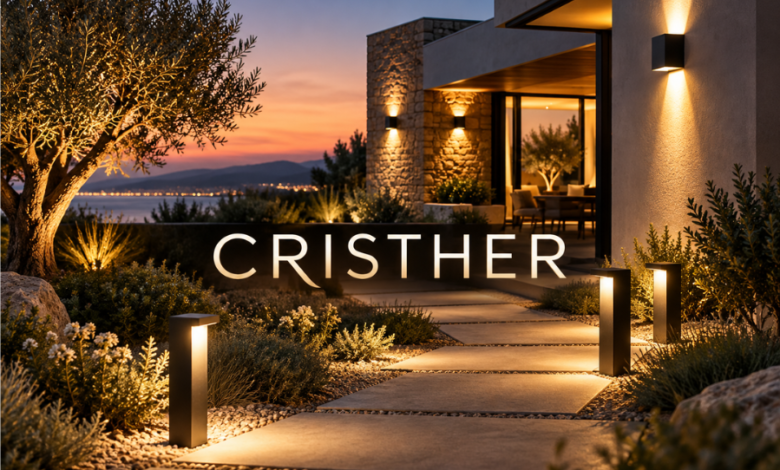
Cristher began in Spain in 1981 as a family lighting business and remains an identifiable name in architectural outdoor illumination more than four decades later. Today, it operates as a specialist brand within Barcelona-based Novolux Lighting, supplying luminaires intended for gardens, building exteriors, pathways and public spaces. Its history reflects the consolidation of Spain’s lighting industry.
The name is sometimes discussed online as though it were simply an unusual personal name. Yet the lighting business has a documented corporate history, a current product catalogue and examples of installations beyond Spain. Its changing ownership, present-day product range and approach to technical specifications reveal how the business developed while retaining a recognisable identity.
A Specialist Brand, Not a Standalone Lighting Group
Cristher is now presented by Novolux as a range focused on architectural exterior lighting. Its products address professional requirements for light distribution, durability and control.
Novolux describes the range in terms of adaptable optics, colour temperatures, dimming, LED configurations and resistance to weather and impact. These specifications matter in exposed installations.
The distinction between brand and company is important. Historical references to Cristher as an independent business describe an earlier corporate structure. Current Cristher products are marketed within the Novolux portfolio rather than by an unrelated company of the same name.
From Family Workshop to the Novolux Portfolio
The corporate timeline begins in 1981, when Cristher was established as a family business. A second family-run lighting enterprise, Dopo, followed in 1990. Their subsequent combination helped provide the foundation for the wider organisation now known as Novolux Lighting.
A major change arrived in 2005, when private-equity investor N+1 acquired the two businesses. Contemporary financial documentation from investment company Dinamia records an investment involving Cristher and Dopo that year, supporting the historical account of the transaction.
In 2006, the businesses were merged into Grupo Gestión Integral Novolux Internacional. The name survived although the original corporate structure did not.
Expansion continued through other parts of the portfolio. Exo was added in 2013, while the Spanish technical-lighting manufacturer Indeluz joined in 2016. Later developments included custom-lighting capability, refreshed group branding and the integration of Canaled in 2023.
In its 2026 catalogue, Novolux marks 45 years since the foundation of Cristher. The anniversary reflects continuity despite changing ownership and technology.
How Cristher Fits Alongside Dopo, Exo and Indeluz
Novolux’s brands address related but different lighting requirements. Cristher concentrates on higher-specification residential and architectural exteriors, while Dopo covers broader functional outdoor applications. Exo specialises in decorative interior lighting, and Indeluz centres on technical interior solutions for spaces such as offices and commercial buildings.
Canaled adds linear systems used in settings including transport infrastructure, car parks and industrial premises. Together, the offerings support coordinated lighting projects.
Cristher’s strength lies in compatible outdoor products addressing different site conditions.
What the Cristher Product Range Actually Covers
Recessed Lighting for Paths and Architectural Details
Recessed fittings place most of the luminaire within a wall or ground surface. They can define steps, mark circulation routes or wash a building detail with light while keeping visible hardware to a minimum.
The Suri and Suri Big families illustrate this approach. Novolux describes versions with one, two or three directions of light output, while a Suri Big product specification identifies an IP67-rated aluminium fitting intended for outdoor passageways. Designers can direct light along or across a route.
Bollards, Columns and Urban Fittings
Bollards are particularly useful where people need guidance without the visual impact of tall lighting poles. The Cristher catalogue includes families such as Dion, Dain, Duomo, Aura and Maxima, offered in different forms and, depending on the model, several heights.
Dain demonstrates the value of a coordinated family. Novolux has described matching recessed wall fittings and bollards designed for paths and walkways. Using related products can give a development a consistent appearance while accommodating different mounting locations.
For larger public settings, the catalogue also includes urban-lighting families. These address streetscapes, subject to project-specific technical requirements.
Adjustable Spotlights and Wall Washers
Spotlights serve a different purpose: they direct attention towards a tree, sculpture, entrance or architectural surface. Cristher’s Disc family, for example, offers multiple mounting arrangements, adjustable orientation, alternative beam angles and several colour-temperature options.
Wall washers distribute illumination across larger vertical surfaces. They are useful when the aim is to reveal a facade’s proportions or texture rather than create a bright focal point. The range includes dedicated wall-washing equipment alongside more concentrated projectors.
Underwater and Colour-Changing Light
The 2026 catalogue also identifies underwater-lighting and RGB control products under the Cristher name. These broaden the design possibilities for pools and water features, where electrical safety, sealing and maintenance access are particularly significant.
A fitting described as suitable for outdoor rain is not automatically suitable for immersion. For submerged applications, the precise manufacturer specification and installation instructions are essential, not optional details.
The Engineering Behind an Outdoor Lighting Choice
An architectural luminaire must deliver more than an attractive photograph. Designers need to examine ingress protection, impact resistance, output, beam spread, colour rendering and operating conditions before they can judge whether a fitting belongs in a particular location.
The familiar IP rating describes protection against dust and water ingress. For example, Novolux specifies IP65 protection for its Turret bollard, while certain Malva recessed fittings are rated IP67. Neither rating replaces installation guidance, especially when fixtures are placed below ground level or exposed to standing water. Drainage and correct cable connections remain decisive.
IK ratings address resistance to mechanical impact. This becomes relevant in public spaces, where equipment may be exposed to knocks, maintenance vehicles or other accidental contact. Even a robust fitting requires suitable positioning and mounting.
Colour temperature also changes a project’s character. Warmer light around 2700K or 3000K can help produce a more relaxed setting, whereas 4000K may suit applications requiring a cooler appearance. Beam angles, shielding and positioning ultimately determine whether the effect is comfortable or glaring.
Dimming adds another layer. Not every product supports the same control method, so compatibility with the chosen driver and building system needs to be checked model by model.
Where the Brand Has Been Used
Novolux’s project archive provides concrete examples of the name beyond product catalogues. It identifies Cristher’s Suri Big recessed outdoor fitting in a passageway installation at Museum Voorlinden in the Netherlands.
The archive also attributes exterior ambient lighting at the Anemos Luxury Grand Resort in Crete to the Cristher Block luminaire. One addresses wayfinding; the other creates hospitality ambience.
Elsewhere, Novolux describes the use of Maxima bollards at the entrance to an authorised BMW dealership in Murcia, Spain. This illustrates how a restrained outdoor fitting can support a commercial entrance without dominating the architecture.
These examples document product use, not authorship of entire projects.
Design Identity and Professional Recognition
The brand’s design work includes collaboration with named industrial designers. Jordi Blasi is credited by the Spanish design organisation ADI-FAD with designing Dion for Novolux Lighting. The product was among those selected for consideration in the 2020 Delta Awards programme.
That documented selection is more precise than broad claims that the entire brand has won major international awards. It also suggests the attention given to fitting proportions and architectural integration, alongside the less visible engineering work.
Novolux maintains design and research capabilities and also works with external designers. In its 2023 customer survey, the group said Cristher received the highest rating among its established brands for product quality and design, although this was an internal survey.
Its professional showroom near Barcelona allows visitors to examine lighting families in person, an important benefit when material finishes, scale and light distribution cannot be judged accurately from catalogue images alone.
Manufacturing, Distribution and the Question of Sustainability
Novolux operates from Santa Perpètua de Mogoda, near Barcelona, where it describes production, logistical and technical facilities serving its brands. The group says its distribution network reaches more than 40 countries across Europe, the Americas, the Middle East, Africa and Asia.
For Cristher, this infrastructure matters because professional projects often require matching products, replacement components, technical drawings and dependable delivery schedules. A convincing design is of limited value if the required fitting cannot be sourced or serviced.
Energy-efficient LED technology is central to many current product families, but sustainability should not be inferred from LED use alone. Service life, repairability, glare control, operating hours and appropriate light levels all contribute to a responsible installation.
What UK and US Buyers Should Check
For architects, contractors and property owners in Britain or America, the first task is to identify the exact luminaire and its current regional availability. A model’s presence in an international catalogue does not establish that every configuration is stocked or approved for every market.
Electrical compatibility is especially important. Buyers should verify supply voltage, appropriate certification, drivers, control protocols, installation conditions and warranty arrangements with the relevant distributor or manufacturer before placing a specification order.
A useful comparison considers the complete installed system: fittings, wiring, controls and maintenance. Comparing the price of two lamps without comparing their delivered light and operating requirements rarely produces a meaningful result.
Cristher in 2026: Continuity Through Specialisation
The 2026 Novolux catalogue continues to give Cristher a defined place, with recessed luminaires, spotlights, bollards, urban lighting and underwater products. This is stronger evidence of current commercial activity than undated directory entries or accounts describing the brand solely in the past tense.
Future direction should be assessed through confirmed products, not market-share predictions. The clearest story is the persistence of a specialist identity within an increasingly broad lighting organisation.
Conclusion
Cristher’s significance lies in the connection between a Spanish family-business origin and a contemporary architectural lighting range. Its evolution into Novolux did not erase the name; instead, it placed the brand within a wider design, manufacturing and distribution network. For professionals assessing exterior lighting, Cristher is most relevant for its range of technical options and documented uses in pathways, hospitality settings and built environments.
Frequently Asked Questions
What is Cristher?
Cristher is a Spanish-origin lighting brand specialising in architectural outdoor luminaires. It began as a family business in 1981 and is now part of Novolux Lighting. Its products cover applications including pathways, facades, gardens and public spaces, rather than a single category of domestic lighting.
Is Cristher still an independent company?
Not in the historical sense. Cristher and Dopo became part of a shared business following investment in 2005 and a merger in 2006. The Cristher name continues as a product brand within Novolux, whose current catalogue and official brand materials identify it separately from the group’s other ranges.
Where are Cristher lighting products used?
Its products are intended for exterior architectural and landscape applications. Novolux identifies examples at Museum Voorlinden in the Netherlands and the Anemos Luxury Grand Resort in Crete. The suitable fitting depends on whether the project requires discreet wayfinding, facade illumination, accent lighting or another specific effect.
Does Cristher make LED lighting?
Yes. Its current range contains numerous LED-based products, including recessed fittings, spotlights and bollards. Output, wattage, colour temperature, beam angle and dimming compatibility vary by model. The technical sheet for the chosen product should be checked rather than assuming all fixtures have identical features.
Can Cristher products be specified in the UK or US?
Novolux describes an international distribution presence and also operates a US-facing business. However, availability and compliance must be established for the exact product, not assumed from the group’s international reach. Local purchasers should confirm certification, electrical requirements, delivery, warranty and ongoing support before ordering.