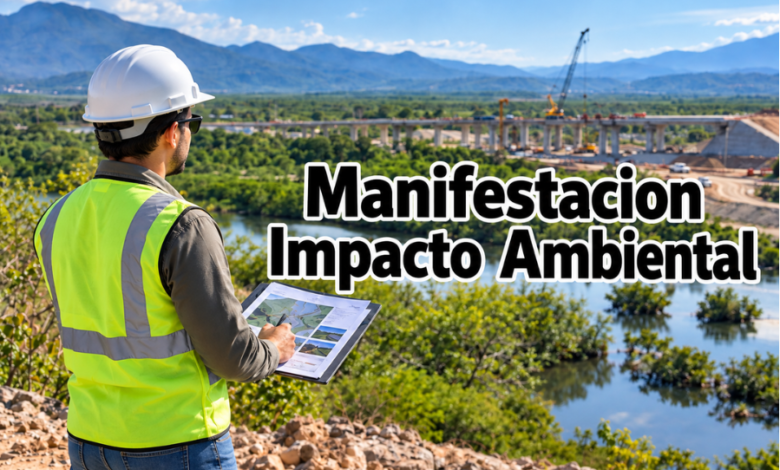
A manifestacion impacto ambiental, more correctly written in Spanish as Manifestación de Impacto Ambiental (MIA), is one of Mexico’s main environmental planning and permitting instruments. It identifies the likely effects of certain projects before construction or operation begins and sets out measures to prevent, reduce or compensate for harm. Under Mexico’s federal framework, the MIA forms part of the environmental impact assessment process through which the Secretaría de Medio Ambiente y Recursos Naturales (SEMARNAT) can authorise a project, impose conditions or refuse approval. For developers, investors and communities, the process can influence project design, location, timing, cost and long-term environmental obligations.
What Is a Manifestación de Impacto Ambiental?
The MIA is a technical document prepared for projects that fall within Mexico’s federal environmental impact rules. It describes the proposed works or activities, the environmental conditions of the affected area, the potential impacts and the measures intended to prevent or mitigate adverse effects.
The broader legal procedure is known as Evaluación del Impacto Ambiental, or environmental impact assessment. Mexico’s General Law of Ecological Equilibrium and Environmental Protection, commonly known by its Spanish acronym LGEEPA, defines this assessment as the procedure through which the environmental authority establishes the conditions that apply to works or activities capable of causing ecological imbalance or exceeding environmental limits.
That distinction matters. The MIA is the evidence and analysis submitted by the project promoter; environmental impact assessment is the regulatory process in which SEMARNAT reviews the proposal and decides whether, and under what conditions, it may proceed.
Which Projects Can Require a Federal MIA?
Not every development in Mexico needs a federal MIA. Federal jurisdiction is linked to categories established by LGEEPA and its environmental impact regulation. Depending on the circumstances, projects involving major hydraulic works, federal transport infrastructure, pipelines, certain industrial activities, mining, forest land-use change, wetlands, coastal environments and works in federally protected natural areas may enter the federal system.
The exact legal classification matters more than a project’s commercial label. A relatively small development may still trigger federal review because of its location, ecological sensitivity or effect on protected resources.
Promoters should therefore determine jurisdiction early. Federal environmental approval does not automatically replace permissions that may be required from state, municipal or other federal authorities. Land-use, water, heritage, construction and sector-specific approvals may still apply.
When an Informe Preventivo May Apply Instead
Mexico’s system also provides for an Informe Preventivo, or preventive report, in certain circumstances. SEMARNAT identifies situations in which this route may apply, including cases where official standards already regulate the relevant impacts, where activities are expressly included in an evaluated development or ecological planning instrument, or where installations are located in an authorised industrial park.
This is not simply a shorter option chosen for convenience. The characteristics of the project determine which procedure is legally appropriate, and the authority may require an MIA where the preventive-report conditions are not satisfied.
Particular or Regional: Choosing the Correct MIA
Mexico recognises two main MIA formats: particular and regional. The difference reflects the geographical scale and environmental complexity of the project.
A regional MIA is required for specified projects and situations, including industrial or aquaculture parks, large aquaculture farms, roads and railways, nuclear power projects, dams and projects that alter hydrological basins. It can also apply to groups of works within a development or ecological planning programme, multiple projects in a defined ecological region, or developments where cumulative, synergistic or residual effects could fragment or significantly affect ecosystems. In other cases, the particular modality generally applies.
A particular MIA concentrates on the project and its area of influence. A regional MIA places the proposal within a wider environmental system and gives greater attention to cumulative pressure, ecosystem fragmentation and regional development trends.
Choosing the wrong modality can lead to delays, additional information requests or the need to restructure the submission.
What Information Does a MIA Contain?
A robust MIA connects engineering, ecology, law and risk management. Its purpose is to show how a project interacts with the environment and whether those effects can be managed within the legal framework.
For a particular MIA, federal rules require core information including project and promoter details, a project description, its relationship with environmental and land-use rules, a description of the environmental system, identification and evaluation of impacts, preventive and mitigation measures, environmental forecasts and supporting methodologies.
A regional MIA covers similar foundations but expands the analysis to the regional environmental system, including development and deterioration trends and cumulative or residual effects.
Baseline Environmental Conditions
The baseline establishes what exists before the project changes the site. Depending on the development, it may cover vegetation, wildlife, soils, surface and groundwater, hydrology, air quality, landscape, climate, noise, ecosystem connectivity and surrounding land uses.
Baseline work is crucial because impact predictions are only as credible as the conditions against which they are measured. Seasonal surveys, suitable geographic boundaries and reliable field methods may be decisive where sensitive species, wetlands, forests or water systems are involved.
Impact Identification and Evaluation
The MIA should explain not only what could change but also the nature and significance of those changes. Relevant issues may include habitat loss, vegetation removal, water demand, altered drainage, emissions, waste, erosion, noise, traffic, fragmentation, accident risks and cumulative pressure from nearby development.
Strong assessments distinguish temporary construction effects from operational and long-term impacts. They also consider indirect consequences rather than treating the project boundary as environmentally isolated.
Prevention, Mitigation and Compensation
Environmental measures should prioritise avoiding harm where possible, reducing unavoidable impacts and addressing residual effects. Examples can include redesigning layouts, protecting sensitive zones, controlling erosion, managing wastewater, scheduling works outside sensitive biological periods, restoring vegetation or implementing monitoring programmes.
The effectiveness of these measures matters because SEMARNAT may incorporate them, or additional requirements, into an environmental authorisation.
How SEMARNAT Evaluates the Submission
Once a qualifying MIA is submitted, SEMARNAT conducts the environmental impact assessment. The authority reviews the proposal against LGEEPA, its regulation, applicable environmental standards and relevant planning or ecological instruments.
Under LGEEPA, the standard statutory period for the environmental authority to issue a resolution is 60 days from receipt of the MIA. The authority may request clarifications, corrections or additional information, which can suspend the remaining evaluation period. Exceptionally, additional time may be justified for complex or large projects.
The practical timetable therefore depends heavily on submission quality. Missing technical support, inconsistent maps, weak impact methodology or an unclear project description can lead to further questions.
In 2026, SEMARNAT expanded digital processing for environmental impact procedures through its electronic environmental window, covering particular and regional MIAs, preventive reports and several related applications. This formed part of a broader move towards simplified and digital environmental administration.
What Decisions Can Follow an MIA Review?
Environmental impact assessment does not guarantee approval. After review, SEMARNAT may authorise the project as submitted, authorise it subject to conditions or deny authorisation.
Conditional approvals can require design changes, additional preventive measures, monitoring, restoration actions or other controls intended to avoid, reduce or compensate for environmental effects. A refusal may occur where the proposal conflicts with environmental law, threatens protected species under the relevant legal standards, or where material information about environmental impacts is false.
For a project team, the decision should be treated as an operating framework rather than a simple licence. Conditions can shape construction methods, monitoring, reporting and later project modifications.
Public Access and Environmental Participation
A major feature of the Mexican system is that environmental impact review has a public dimension. Once SEMARNAT receives an MIA and forms the corresponding file, the documentation is made available for public consultation, subject to legal protections for qualifying confidential commercial or industrial information.
LGEEPA also provides mechanisms through which members of the affected community can request a public consultation. The process can allow interested parties to examine the MIA and submit observations or proposed preventive and mitigation measures.
This makes transparency a practical project issue. Inconsistent descriptions, weak data or vague mitigation can create regulatory problems and undermine confidence in the assessment.
Why MIA Quality Can Affect Project Value
For developers and investors, the MIA may influence more than environmental compliance. It can expose constraints that affect design, capital expenditure, construction scheduling, financing assumptions and the viability of a location.
Identifying those issues early can prevent expensive redesigns after land acquisition or engineering commitments have advanced. Treating environmental assessment as late-stage paperwork can have the opposite effect, particularly where sensitive habitat, forest land-use change, cumulative impacts or additional studies become relevant.
A strong MIA also creates a clearer record of environmental commitments that must later be translated into site controls, monitoring and documentation.
Common Weaknesses That Can Undermine a MIA
One common problem is a mismatch between the project description and environmental analysis. If access roads, utilities, temporary works, waste areas or associated infrastructure are omitted, the assessment may underestimate the actual footprint.
Another weakness is an overly narrow area of influence. Water flows, wildlife movement, traffic, emissions and cumulative pressure rarely stop at a property boundary.
Poor baseline data can be equally damaging. Surveys conducted at the wrong season, with weak methods or insufficient spatial coverage may not support reliable conclusions.
Mitigation should also be specific and measurable. Vague commitments to “minimise impacts” are less useful than measures linked to responsibilities, locations, performance criteria and monitoring.
Conclusion
The manifestacion impacto ambiental is a central part of Mexico’s federal environmental decision-making system. Its value lies in testing a project before irreversible commitments are made: defining environmental conditions, identifying impacts, assessing risk and establishing measures that can be enforced throughout development and operation.
For project promoters, the strongest approach is to treat the MIA as an early planning instrument rather than an administrative formality. Correctly identifying the required modality, building a defensible baseline, assessing cumulative effects where relevant and proposing practical mitigation can improve both regulatory clarity and project resilience. For communities and regulators, the process provides a structured basis for deciding whether development can proceed without unacceptable environmental harm.
FAQs
What does manifestacion impacto ambiental mean?
It refers to Mexico’s Manifestación de Impacto Ambiental, commonly abbreviated as MIA. It is a technical environmental document submitted for projects that require federal environmental impact authorisation. The MIA describes the project, existing environmental conditions, likely impacts and proposed measures to prevent, mitigate or compensate for harmful effects.
Is an MIA required for every construction project in Mexico?
No. The requirement depends on the project type, location, scale and applicable federal environmental rules. Some works fall under state or local systems instead, while certain federal cases may qualify for an Informe Preventivo. Early legal and technical screening is important before assuming which route applies.
What is the difference between a particular and regional MIA?
A particular MIA focuses on a specific project and its area of influence. A regional MIA is used where the law requires a broader assessment, including certain major infrastructure projects and situations involving cumulative, synergistic, residual or ecosystem-fragmentation effects across a wider environmental region.
How long does SEMARNAT take to evaluate an MIA?
LGEEPA establishes a 60-day period for issuing the corresponding resolution after receipt of the MIA, but the process can be suspended if SEMARNAT requests clarifications or additional information. Complex projects may also justify additional time under the applicable legal framework.
Can the public review or comment on an MIA?
Yes. Environmental impact files have public-access mechanisms, and Mexican law provides for public consultation in qualifying circumstances. Interested people may be able to review the MIA and submit observations or proposals concerning prevention and mitigation measures during the established process.